Showing posts with label life is tough. Show all posts

Monday, March 22, 2010

Quick(er) Hits: Part II

I'm seven five books behind in posting, not including posts already in draft. A bunch of new books just came in, which is going to get me even further behind. So I'm just going to do a some quick impressions of a few of the books I've recently finished.

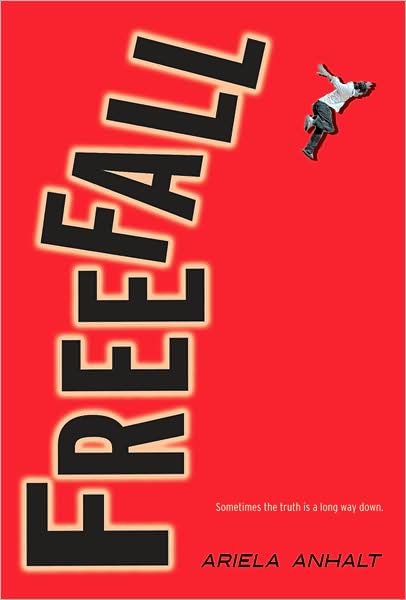
Freefall by Ariela Anhalt
4Q 3P; Audience: S

Three boys went up to the cliff. Two came down alive. One didn't. Did Russell fall or was he pushed? If he was pushed, was it on purpose or not? Luke is the only known eyewitness, and everyone wants him to tell what he saw that night. Hayden is his best friend and roommate, but if Luke is being honest, he knows that Hayden pushed Russell that night. But he's not sure what Hayden's intentions were when he did it. Trying to figure out what happened and why is tearing Luke up, and he can't bring himself to talk about it.

This isn't a book you pick up when you want a nice, cozy read. Luke's a mess. Not only is he dealing with the events up on the cliff, he's dealing with his father's suicide and its aftermath. He's angry, he's lonely, he's confused, he's guilty, and he's in a lot of pain. Like Cass and Tim in Give Up the Ghost, he needs help and refuses to ask for it. My heart ached for him, but I also got annoyed, because people do try to help him, and he rejects them every time. That's consistent with his personality and his issues, but it sure was frustrating! I felt the strengths in this book were the build-up of tension (internal and external) in a very narrowly focused storyline, Luke's very realistic struggles with deciding not only what he saw but what is the right thing to do about it, and the characters' interactions. Anhalt is still a college student herself (at Dartmouth), and she's right on the money with the way teens and young adults speak to each other. (People who object to cursing in general or in books should keep that in mind.) This book may not fly off the shelves, but a good booktalk should sell it to readers who enjoy introspective reads and character development over plot.


Crazy Beautiful by Lauren Baratz-Logstead
3Q 3P; Audience: J/S


Lucius blew off his arms in an explosives experiment that went horribly wrong. Instead of replacing them with realistic prosthetics, he's opted for hooks, a pretty clear indication that he intends to keep people at a distance. A very intelligent loner even before his accident, Lucius has come to accept his outcast status. That changes when Aurora steps onto his bus. Not only is Aurora beautiful, but she also is somehow both willing and able to look past his disfigurement to see the person he truly is. That's actually a somewhat frightening prospect, because Lucius has secrets he's not proud of, and the thought that learning the truth about his accident and the kind of guy he used to be might make Aurora shun him scares him. But Aurora knows more about pain and loss than Lucius suspects, and a tentative friendship begins. It's a friendship that doesn't go down well with the popular kids, especially Jessup, who has his eye on Aurora too. Jessup sets in motion a plot to make Lucius pay for attracting Aurora's attention, and soon Lucius finds himself even more of an outcast than he was before. Even Aurora has turned against him. Now what?

This story has some beautiful moments, especially in scenes between Lucius and Aurora. Told in first person by both characters, we frequently see the same scene from both points of view, which can be illuminating. Lucius has enough warts to make him intriguing. He doesn't spill all his secrets right away, so we don't know what happened to him or why. He's clearly intelligent, and he clearly has always felt superior to most of the people around him. He's also guilty about what he did (whatever it was) and how it's affected his family. You get the sense that he's not who he used to be and that he's realized he'd like to be a bit more a part of things, but he doesn't quite know how to go about this business of being friendly, let alone being a friend. For the most part, I thought Baratz-Logsted handled his attempts to grow quite deftly. Aurora is a far more idealized character. She's handling the death of her mother with grace. Immediately accepted into the in crowd at her new school, she is aware enough to realize that she may not want to be a part of it and that Lucius is a more authentic, interesting person to be with. It is impossible not to feel drawn to her. She's the epitome of nice, sweet, and friend. So once Jessup's plot started rolling, I was surprised she didn't see through it and nip it in the bud. This is when the book started to strike some significantly discordant notes for me. I flat out didn't believe the ending. Without saying too much, questions weren't asked by characters who would have asked them, and Lucius becomes some sort of magician in his ability to make people listen to him when they never have before, in situations where they were not at all likely to be willing to listen. I understand that this is supposed to be a retelling of Beauty and the Beast, but this fairy tale ending didn't match the rest of the story.

Some of the writing is beautiful and evocative. I'm not going to quote widely here, but here are two sections that I marked:


I feel as though my whole body could explode at her touch. Nobody ever touches me if it can be avoided. And, for the most part, I have been content to keep the world at this distance; at arm's length, if you will. But not now. This is the first time that anyone outside my family has touched me in a very long time, and my entire body feels it, enjoys it, fears it. (p. 119)

This is, I think, what it must mean to be human: to want something good for someone else. (p. 126)


Tuesday, March 09, 2010

On Keeping One's Distance, Purposely and Not

I'm really far behind in posting on books I read in January and February, so I'm going to try to toss up a few slightly shorter posts. (Of course, with me, slightly shorter generally means five or six paragraphs instead of seven or eight! So shorter is definitely a relative term!)

How to Say Goodbye in Robot by Natalie Standiford (4Q 3P) has already gotten all kinds of attention in blogs and review journals. It seems to be one of the hot books of the season so far. While I enjoyed reading it, I don't think it's going to be on my top ten of 2010 (technically, it's from late 2009, but I read it in January).

Bea is accustomed to moving, but this time, things are different. Nobody wants to start a new school in their senior year. And her mother is acting very strangely. She's crying at the drop of a hat and fixating on chickens. When Bea refuses to cry when a gerbil that isn't even theirs dies, her mother calls her a robot for being so heartless. Bea decides being robot-like isn't such a bad idea. Things hurt less when you don't feel anything. so she decides not to feel anything. She meets Jonah at school, where she's purposely keeping her distance from everyone. Jonah's been called Ghost Boy for years, both because of his albino-like appearance and because he keeps such a low profile that he's practically invisible. For some reason, Jonah will talk to Bea, and he's the one person she lets into her life in any meaningful way. Jonah finally reveals the tragedy that's been the driving force in his life: the death of his mother and twin brother in a car accident. When Jonah discovers that his father has been lying to him about the accident and its aftermath for years, he and Bea go on a seemingly hopeless quest to find the one thing that can fill the hole in his life.

Musings:

Bea and Jonah keep people at arm's length, and that's pretty much how I felt about them too. I didn't connect to them at the level I wanted to, even though Jonah's situation was infuriating and very sad. Bea's story might have been more compelling for me if it had continued to develop in the direction it seemed to be going. But ultimately, the issues surrounding her mother didn't hold together for me. I couldn't buy the reactions that resulted from the cause. I did like the use of the late-night radio show and its quirky loyal followers to give them a place they could fit in and be accepted. Those sections were a welcome relief from the cold, like cuddling up with an afghan and cocoa after being outside on a dreary February day.

Food for thought: Are Bea and Jonah good for each other? Is Jonah what Bea needed at the time, or did their friendship reinforce her robot responses to everyone else around her? Would it have been healthier for Jonah if Bea had encouraged him to handle his discovery of his brother and his father's decision differently? Are Jonah's actions at the end selfish or self-preservation?

Wednesday, February 03, 2010

To Be or Not To Be...a Virgin

It was a coincidence that I picked up two books back to back about teens losing their virginity, but it makes sense to talk about them together. The main characters in the two books have made very different decisions about sex, for very different reasons, and both are forced to confront those decisions when a seemingly casual encounter with a boy pulls them up short. But as interesting as their stories were, I found myself paying at least as much attention to the secondary character in each book who decides to lose his/her virginity as a result of societal pressures. More on that below. I found both books to be good reads and worth thinking and talking about, but it is the Knowles book that will stick with me longer and which I think will resonate most with its readers.

JUMPING OFF SWINGS by Jo Knowles
5Q 4P; Audience: S


All Ellie wants is to be loved. She wants that feeling you get when someone holds you close, kisses you, cares for you. Each time she sleeps with a boy, she thinks that's what she's going to get. But instead of feeling loved, she just feels empty and just hates herself a little more. The night she hooks up with Josh, they both have high hopes. He's tired of the guys in the locker room teasing him about being a virgin. They tell him Ellie will take care of his problem ("She's really into it!"). After a few minutes with Ellie, he's no longer a virgin. But one glimpse of the look on Ellie's face as he walks away leaves Josh feeling ashamed, not relieved or ecstatic. As for Ellie, she hopes this time it will be different, that Josh will be different. But he's not. She still feels just as empty, just as unloved. The only thing that's different is that this time Ellie gets pregnant.

Told by Ellie, Josh, and their best friends Caleb and Corinne, this is a poignant, makes-your-heart-hurt story. Nobody is a villain here. Ellie's need for love leads her to keep making poor choices. Josh is embarrassed and ashamed when he realizes too late that Ellie wanted and needed something from him that he was not prepared to give. He's shocked and confused when he learns she's pregnant and totally at a loss about how to handle the situation. Corinne tells her side of the story as a loyal friend who is sometimes frustrated by Ellie but who will always stand by her. Caleb's story is the pain of having to watch someone he loves hurt so much, unable to tell her how he feels.
There were so many things to like and admire about this book. The three-dimensional characters and their actions and reactions ring true, Ellie and Josh in particular. I really appreciated that Josh was portrayed as someone in as much pain and confusion as Ellie, rather than as callous or callow. I loved Caleb's mother, both as a character and for being there for Ellie when her own parents aren't. I loved the warmth of those scenes contrasted with the emptiness of so many of the others. And I loved that there are no easy choices here and that Knowles didn't tie everything up in a perfect little bow at the end. There's so much more to say about this book, although I've already said too much.

GIVING UP THE V by Serena Robar

3Q 4P: Audience: S


Spencer Davis's mother's idea of a perfect 16th birthday present for her daughters is a trip to the gynecologist for their first exam and a prescription for birth control pills. It is not Spencer's ideal gift. She's mortified, though her friends (guys and girls) all think it's terrific. They all expect Spencer to take full advantage of the situation. But Spencer has no interest in losing her virginity right now. For one thing, other things are a lot more important to her. For another, there's nobody she's even remotely got her eye on, and she wants her first time to be with someone who is special, so that it means something to both of them. In contrast, her best friend Alyssa just wants to get it over with. She's even made a list of guys she's willing to give it up to. Complications arise when Benjamin enrolls in their school. Suddenly Spencer isn't so sure that she has no time for boys and serious dating (and perhaps more). She's thrilled every time he talks to her, and her body tingles every time he touches her. Now she gets what this whole sex thing is all about, and having those birth control pills in hand is looking like a very sensible present after all. The trouble is, Alyssa just moved Benjamin to the top of her lose-it-to-him list, and she's doing everything in her power to make sure Ben knows it. Should Spencer pretend not to like the boy she can't stop thinking about so her best friend can have him? (Or, rather, he can have her.) Or should she go after him herself to see if she's ready to give up the v after all?

This book is a fairly intelligent look at teens who are trying to decide what is right for them in terms of their sexuality. It's fair to say that while I recognize that Alyssa is representative of many young girls, I had a hard time sympathizing with her goal.
I think it's a shame that there's so much emphasis on sex in our culture that some teenagers "give up the V" because they don't want to deal with the pressure. What I appreciated about Spencer was that she wouldn't allow herself to be coerced into something she wasn't ready for just because her friends and/or society were telling her she should be. It's not surprising that I, as an adult, feel that way. I wonder which of the two girls most readers will empathize with.

These two are on either end of the spectrum. Also represented are Spencer's friends, most of whom are happily and vociferously sexually active, either as part of a (frequently battling) couple or playing the field.
Though the energy level in the book goes up a notch or two whenever they are on the page, they're stock characters and a bit overdrawn. I found myself wondering on more than one occasion how Spencer fit in with this group. I had the feeling that this was a group that may have been close friends at one time, but would more likely have grown apart over the years. It has only just occurred to me that they're in the book primarily to represent that full spectrum. They are also quite raunchy and randy, making for one more reason this book is recommended for older teens.

I found the ending to be predictable, but I think readers will appreciate it, regardless.

Friday, November 06, 2009

Snarky and Sad

Cracked Up to Be by Courtney Summers
4Q 3P; Audience: S

A couple of months ago I was on the hold list for several books that hadn't come in yet (naturally, later about six of them came in at once!) and the books I wanted to read otherwise were all checked out. I was searching desperately for something captivating to read. I was working in the Teen Room when one of my teen regulars started talking about a book from my New Books display she'd been reading, saying it was really funny and very good. She couldn't take it out at the time, so I snagged it. Thanks for the recommendation, Adriana! It was exactly what I was looking for.

I laughed in the beginning, too. I enjoy a good bit of snark, and Parker Faraday is very, very good at snark. But as I read on, the more it became apparent that this is no light-hearted book, and Parker is not a happy girl. In fact, Parker has been on a downward spiral for months. She's gone from being the straight-A's captain of the cheerleading squad to flunking her classes and alienating all her friends. She's having panic attacks. She's come to school drunk and attempted suicide. What we don't know is why any of this happened. And that is only revealed little by little, mostly at times when Parker is desperately trying (and failing) not to remember.

Parker makes no effort to be a nice person. She gets a charge out of her ability to manipulate people. Crying and alluding to her suicide attempt are good ways to get her parents and guidance counselor to back off. She uses sarcasm, brutal honesty, and downright unkindness to push everyone close to her away. She sets her former boyfriend Chris up with Becky, the new captain of the cheerleading squad who sets her teeth on edge, then proceeds to rub Chris's obvious preference for her in Becky's face. When a new boy asks stops her to ask where the art room is, she tells him she can't stop to talk since she's late for class. Ten minutes later, he walks into the art room, only to find her sitting there waiting for him.

That new boy is Alex, and much to her chagrin, he isn't easy to push away. First of all, he's her partner on an art project. Secondly, he's intrigued by her. As hard as she tries to alienate him, he keeps coming back. Chris and Becky, too, refuse to go away. And the more they hang around, the harder it is for Parker to lie to herself, to forget what she's trying to forget. She's trying to hold it together long enough to graduate and get out of this town forever, but the memories and the guilt keep coming back.

Musings:

I was very surprised at the turn this book took. The first few pages didn't prepare me for the guilt, aching sadness, and desperate fear that lie underneath Parker's facade. I think that's way Parker would want it, and it's a really effective way of mirroring what's going on with her.

The push-pull of Parker's relationship with Alex is very well done. When Parker decides that at some level she wants Alex in her life, she's very upfront with him: she kiss him and maybe even sleep with him, but she'll never be his girlfriend, and she'll never say she loves him. He's free to use her, too. But underneath it all, what she won't admit to herself is that she's relieved he won't go away. Alex's reactions to all of this are honest and believable. I hurt for him, but I had to admire his own inner strength as he seems to understand at some level Parker's need to use him as a punching bag.

While the actual events that lead up to Parker's crash and burn are fairly easy to guess at after the first few flashbacks, what I found truly fascinating was what got her into the situation in the first place. What we often look at as a positive personality trait can in fact be very destructive, a truth that's often not apparent until the situation reaches a crisis point. I think a lot of people (not just teens) will relate to the pressure Parker feels and the panic and anger that follow when she realizes that trying to live up to her own and everyone else's expectations just isn't possible. What follows may be extreme, but by the time I learned the whole truth, I was willing to follow wherever Summer led me.

This is not a light read. Alcohol plays a big role in Parker's downward spiral, and she's matter-of-fact about her sexual experiences. The emotions and sometimes the language are rough. Parker may not be forthcoming about what happened in the past, but she's not pulling her punches about how she sees things in the present. Older teens who like books with an edge will appreciate all of this. Younger readers and those who prefer a softer picture of adolescent life would probably prefer to look elsewhere. As for me, I'm looking forward to reading Summers's upcoming book, Some Girls Are.

Monday, April 20, 2009

Real Girl vs Winter Girl

Wintergirls by Laurie Halse Anderson
5Q 4P; Audience: (J)/S

Horrifying. Mesmerizing. Shocking. Tragic. Heartrending. Devastating. Exhausting. Unforgettable.

Back when Lia was a real girl, her parents weren't divorced. She had a best friend. She wasn't a fat pig. She wasn't starving herself. She wasn't cutting. She wasn't a wintergirl.

Wintergirl. Dead girl walking. That's what the kids at school call her. Being a wintergirl is just fine with Lia. That way she doesn't need to feel anything. But it doesn't really work that way. Lia feels too much. She just wishes she didn't feel anything. That was easier before Cassie died, before Cassie started haunting her, leaving her scent of cinnamon, cloves, and sugar hanging in the air along with her accusations and her entreaties to join her on the other side.

Lia and Cassie were best friends, right up until they weren't. They played together, got crushes on boys together, hated their parents together, got drunk together. They made a pact together: they would be the skinniest girls in school. ("But I'll be skinnier than you," said Lia.) Cassie binges and purges. Lia starves herself. They'll stay strong together. And then one day, Cassie turns her back on Lia. She won't even speak to her. Which is why, months later, Lia doesn't answer the phone when Cassie calls and calls and calls. (1...2...3...8...10...15...18...22...25...29...30...31...31...32...33. Silence.) Cassie is talking to her now. Now that she's dead, Cassie won't stop speaking to Lia, creeping into her room at night, following her to appointments, haunting her. If Lia stays strong, maybe she can make Cassie go away. Maybe she can make everything go away.

Musings and Quotes:

This was an achingly difficult and utterly engrossing book. While making note of some of the lines I wanted to quote, I also wrote "I feel trapped." There were times I felt I couldn't breathe. I could read only thirty or forty pages at a time before I had to take a break from it. But not everyone will feel that way. I handed the book to my fifteen-year-old niece and she didn't pick her eyes off the pages until she finished it less than four hours later.

The use of strikeouts ("my parents Dr. Marrigan and Professor Overbrook" or (paraphrasing) "I just want sweet, creamy, delicious ice cream slipping down my throat dry toast") to show the difference between what Lia thinks and feels and what she'll allow herself to acknowledge is brilliant.

There's a quotable line on every page (every paragraph). The language is evocative and the imagery is stunning. I know that I'm going to get hundreds of hits on this page, because that's what happens when I quote from Laurie Halse Anderson. Please, do yourself a favor. Read the book. Let yourself be moved by it. Quotes can give you the flavor of a book, but they can't do justice to it.


"Here stands a girl clutching a knife. There is grease on the stove, blood in the air, and angry words piled in the corner. We are trained not to see it, not to see any of it. (...body found in a motel room, alone...) Someone just ripped off my eyelids." (p. 4)

"If I weren't so tired, I'd shove trust and issue down the garbage disposal and let it run all day." (p. 6)

"Last week's Thanksgiving was artificially sweetened, enriched with tense preservatives, and wrapped in plastic." (p. 30)

"Hundreds and hundreds and hundreds and hundreds of strange little girls screaming through their fingers...I scroll through our confessions and rants and prayers, desperation eating us one slow bloody bite at a time." (P. 112)

" 'What words are in your head right now, Lia?' Pissed. Pig. Hate...Jail. Coffin. Cut...Hungry. Dead." (pp. 115-116)


"I'm sure she's [Lia's mother] waiting for me in the family room, temperature at fifty-eight degrees, her lecture notes neatly arranged with my faults and mistakes listed in order of priority. She has charts to prove everything I do is wrong, and that my only hope is to allow them to insert her stem cells in my marrow so she can grow a new her dressed in my skin." (p. 148)

"Cassie opens her Pandora's box every night and hitches a ride to my room. She doesn't watch from the shadows anymore. She attacks. Once the sleeping pill straps my arms and legs down to the mattress, she opens my skull and rips out the wiring. She screams holes in my brain and pukes blood down my throat." (p. 183)

Laurie Halse Anderson has done it again. Wintergirls is going to join Speak as one of the classics of YA literature.

Thursday, April 09, 2009

To Sleep, Perchance to Dream

Wake by Lisa McMann
4Q 5P; Audience: J/S (gr. 9+)


Even though I love to sleep, I hate to go to sleep. That's only because I'm a real nightowl, though. Fortunately, I don't have Janie's problem. It's not actually the sleeping that's a problem for Janie. It's the dreaming. When she was eight years old, Janie discovered that she could actually enter people's dreams, see what they're seeing and feel what they're feeling. Ever since, she's been afraid to fall asleep, especially if anyone else is sleeping nearby. What if she accidentally falls into someone's dream? She's seen some pretty unnerving things. Mr. Reed at the old age home? His dreams are about war, being shot, and his body parts falling off. Her best friend, Carrie? She dreams about a drowning boy. And in their dreams, all of these people look at Janie and plead, "Help me. Help me, Janie." How? How can she help them? What is she supposed to do in a dream?

None of these dreams compare to the ones she's been having recently. Sometimes there's a middle-aged man and a younger guy, a huge monster-man who has knives for fingers. And he uses those knives on the older man in horrible ways. Sometimes the dream is even worse. Sometimes the monster-man is coming after her.

Janie doesn't know why she has these dreams or what she's supposed to do with them. She just wishes they would stop. She has nobody to talk to about them. Her mother is an alcoholic who rarely has a sober moment, and Carrie's too busy with her boyfriend. She has nobody else. Except, perhaps, for...Caleb Strumheller? Caleb's been trouble and stoned since ninth grade. But there's something different about him this year. He looks more put together. He even talks to people on occasion. And there's the way he looks at her, the way he seems to see right into her. In some weird way, he seems to be involved in her dreams already. Maybe that means something. What would happen if, for a change, she took a cue from the people in her dreams and asked him for help?

Together, Caleb and Janie begin to puzzle out the secret of her dreams. But there are things Caleb isn't telling her, and Janie's nightmares are far from over.


Musings:

I didn't know what to expect from this book. I was a little confused when I first began reading it. It took me a while to get used to the jumps in time and to catch on to what was going on. But once I got into it, I was hooked. It's a compulsively readable book. I'm not going to pretend that I couldn't predict what was going to happen in a few instances. This isn't a goes-where-no-author-has-gone-before book. But it didn't matter. The situation was fascinating enough that I just wanted to keep reading. Janie has complexity and her voice is spot-on, and I found her a totally believable character. I thought the evolution of her relationship with Caleb was handled well. On the other hand, I thought she was a little obtuse on the subject of Caleb's and Carrie's secrets. But perhaps that's because I have a few years on her.


I was surprised when I looked at the front of the book and found excerpts of rave reviews from several review journals. It has 192 customer reviews on BN.com (I've never seen more that a dozen there) and 72 on Amazon. How did I miss this book when it first came out? However it happened, I've already made sure that my patrons and I won't be missing Fade, the sequel. It's already on order. (There will be a third book in 2010.) Bring on the lucid dreaming !

Friday, January 09, 2009

Hey, Big Spender, Let's Dance!

Ten Cents a Dance by Christine Fletcher
5Q 3P; Audience: J/S (Grade 9+)


It's Chicago, 1941, and life is tough in the Yards. Money is hard to come by at the tail end of the Depression, especially if you're female and young. Ruby Jacinski's mother's rheumatoid arthritis is so bad, she can no longer work in the meat factory. Ruby has no choice but to drop out of school and get a job to support herself, her mother, and sister. She too goes to work in the hated meat factory, and she loathes every minute of the dull, smelly, bone-aching work. The only bright spot in her life is when she gets to dance. When Ruby hears music, her body wants to take off into it. When she dances, people stop to watch. That and her feisty personality bring her to the attention of Paulie Suelze, recently dishonorably discharged from the Army and a small-time hood on the rise. If her mother knew she'd talked to - kissed! - Paulie Suelze, Ruby's life wouldn't be worth a plugged nickel. But Paulie is exciting, dangerous, and handsome, and all three qualities are appealing to Ruby. Just as appealing to her is the new work he suggests for her. Why not earn money doing the thing she most enjoys doing? Why not teach dancing at the Starlight? Instead of $12 a week, she could earn $50. She could pay off their back rent and grocery tab, get her mother's wedding ring out of hock, and maybe even earn enough to get them out of the Yards and into a nice place. What's not to like about a job like that? As far as Ruby's concerned, this is a wonderful opportunity. But she knows that as far as her mother is concerned, Ruby's dancing with strange men for money is one step short of going to hell in a hand basket. It's just the first of many secrets she has to keep from her mother.

Ruby soon discovers that Paulie hasn't given her the full story either. She isn't a dance teacher. She's a taxi dancer. She dances with men who buy her time. And if she works it right, they'll buy her dinner, too. They'll take her out to night clubs. If she sets her line just right, these fish will show her a great time, and all it will cost her is a few dances and a few stepped-on toes. But Ruby is far more naive than she thinks, and before long, she's got herself caught up in a real mess, and the only person who can get her out of it is Paulie Suelze. Dangerous, charming Paulie, who makes her heart race. Dangerous, charming Paulie Suelze, who can't be trusted.

Musings:

Everything in this book is sharply drawn, from the characters right down to the details that bring the early 1940's alive. Ruby is a multifaceted protagonist, and there's no attempt made to make her look particularly good. She makes plenty of mistakes, she's headstrong, cocksure, and unwilling to listen to good advice. She's a naif who thinks she knows it all, and it takes several knocks for her to even begin to realize that she doesn't. Ruby knows how to stand up for herself, but doesn't always know when to lie low. And she most certainly isn't a good judge of character. But Ruby is loving, loyal, and good-hearted, and she can look past her prejudices to value an individual. You get the sense at the end of the book that Ruby has grown a lot and is becoming not only a woman to be reckoned with, but a woman who has learned from her mistakes and is the wiser and better for it.


Atmosphere simply oozes out of this book. With talk of iceboxes, cold water flats, one bathroom shared by an entire apartment building, one telephone in the neighborhood, dancing at the corner drugstore, "black and tans", and the knowledge that everybody knows everybody's business, the 1940's come alive. Period detail extends to the casual use of derogatory terms and rampant racism and male-female relationships. Ruby is at first appalled at the idea that she has to dance with black and Filipino men and her fish (men she has on a string) insist that she does not. Her friendship with a trumpeter in the band has to be their secret, and going to jazz clubs where blacks and whites mingle is scandalous and dangerous. Women are subordinate to men and most just want a man to take care of them. A man beating a woman on a public street simply means that people walking by avert their heads and continue on their way. Premarital sex is wrong, and once you've had it, you know too much to ever be a carefree girl again. Fletcher effortlessly blends all of these elements into her novel, letting period detail enrich rather than overwhelm her story.

This is a book that adults will read with as much enjoyment as teens. Highly recommended.

Friday, December 05, 2008

Liberty for All?

Chains by Laurie Halse Anderson
5Q 3P; Audience: M/J


By all rights, Isabel and her sister should be free. That's what it said in Miss Mary Finch's will. But Miss Finch's nephew refuses to believe Isabel or even to read the will. To him, Isabel and Ruth aren't girls, they're money in his pocket. To their new owners, Master and Mistress Lockton, they are hands, feet, and strong backs. They certainly aren't people.

It is particularly galling to be a slave when all around you the talk is of liberty, freedom, and independence. In 1776, those words were on every American's lips, though some spoke them with passion and desire and others said them with scorn and fury. Isabel and Ruth are caught in the middle of the battle, in more ways than one. The Locktons are Loyalists, true to the British Crown and up to their eyeballs in plots to bring the upstart Patriots to their knees. Curzon, a slave in a Patriot household, coerces Isabel into spying for the rebels. It is the Patriots, he tells her, who will give the slaves their freedom. If she throws in her lot with them, the liberty she craves will be hers. It is not an easy decision. The Locktons are not kind masters. If she spies and is caught, she will pay in ways too horrible to imagine. She isn't concerned only, or even primarily, with herself. Ruth is only five and prone to fits. If anything happens to Isabel, who will care for and protect Ruth? Still, Isabel burns with the desire to be free. It is worth taking the risk.

With the stakes are so high, it is all the more crushing when Isabel is forced to realize that the Patriots' passion for liberty is limited. Despite their fine talk and promises, the freedom they seek does not extend to slaves. They will not help her, and they will not protect her. Has she put her life and her sister's in jeopardy for nothing?

Musings

It is easy to understand why this book was nominated for the National Book Award (Teen category). It is beautifully written. Anderson excels in both character and plot, and her writing is graceful and compelling. Isabel is feisty, strong, loving, rebellious, and determined. She is often afraid but always courageous. She's no paragon, which makes her seem all the more real. Mistress Lockton and Lady Seymour are two sides of a coin, one loathsome and one as good as the times allow her to be, and both evoked visceral responses. Images of Curzon stay with me, too, as I picture him first cocksure and confident and then diminished by betrayal and circumstances. Because these characters are so vivid, even readers who are neither fans of historical fiction nor interested in the historical period will be swept up in Isabel's story. Anderson has the wonderful ability to drop nuggets of information into her story in a way that never seems forced or obtrusive. I knew New York was important strategically, but I didn't realize what a hot bed of Loyalists it was or that a great fire destroyed much of the city. I certainly didn't know about the enticements both sides offered to slaves and indentured servants in order to coerce their support, nor how often those promises proved false. This book does, of course, present those promises from Isabel's point of view, and certainly not every army officer (or founding father) consciously
used slaves' desire for freedom to their own advantage (consciously being the operative word here), with no personal regard for the slaves themselves. But Chains brought home to me forcefully and movingly the hope and heartbreak of having liberty so enticingly close, only to have it snatched away, as well as the irony of promising "liberty...for all" and giving it only to some.

I am glad that we will be hearing more about Isabel and Curzon in the future. I am not ready to leave them behind.

Thursday, November 13, 2008

Nuclear War or Just Plain Madness?

The Compound by S. A. Bodeen
3Q 3P; Audience: J


Imagine that you've just been told that a nuclear airhead strike has just been launched at the United States. Where would you go? What would you do? Fortunately, Eli doesn't have to wonder. His father has been preparing for this moment for years. He's built an underground compound for the family and stocked it with enough food and clothing to last fifteen years, long enough for the nuclear fallout to dissipate enough for safety. When the warning comes, the family is able to get to the shelter in time. All of the family except for their grandmother and Eli's twin, Eddy, that is.

Eli has known for years that Eddy is the good twin. He was the one that everyone liked and wanted to be around. Eli was the one the other kids accepted because he was Eddy's brother. Eli is the selfish one. He knows it's really his fault that Eddy and his grandmother didn't make it into the shelter, and he'll never forgive himself for that. Eli's pretty much decided that he won't love anyone anymore. He hasn't let anyone touch him in ages. He barely talks to his sisters (one older, one younger) and avoids his parents. He's angry and he hates everything about where he is and how they live.

The compound is stocked with everything a family could need: clothing in various sizes, plenty of books and music to keep them occupied, even computers and lessons so that they can continue with their schooling. It has plenty of food, too. Until it goes bad, that is. The animals die, too, due to poisoned feed. What looked like a fifteen-year food supply isn't going to last even half that long. That's why Eli won't go through that yellow door. He doesn't see how his mother and sisters can bear it. Because what's on the other side of that door -- the Supplements -- no. It doesn't even bear thinking of. It's too gruesome and sick to even contemplate.

Living in the shelter is hard on all of them. His little sister goes around talking in an English accent all the time, and his older sister doesn't talk much at all. His parents obviously get physically close, since his mother has been pregnant pretty much continuously in the six years or so they've been in the compound. But they don't seem to like each other much. His mother's okay. If Eli can bear to be around anyone, it would probably be her. But his father is getting stranger all the time. Sometimes he rushes around in a frenzy of energy, and other times he'll stay in bed for days. He controls everything they do. They're all just a little afraid of him. As it turns out, they should be.

It's not until Eli accidentally stumbles on a computer meant for Eddy that the horror of his situation starts to become clear. Because unlike all the other computers in the compound, this one connects to the Internet. How can there be an Internet? Wasn't the world destroyed? Apparently not. And when Eli actually gets on the Internet himself and sees what he sees...well, then he begins to question everything that's happened in the past six years.

Could it possibly be that his father was lying to them all the time? And if that's true, what possible reason could he have for keeping them locked up in this compound? Is reason the wrong word to use in connection with his father? What do you do when you are locked in an underground compound with an insane man who is the only person who knows the key to getting out of it?

Though not a perfect story, this is still a book that will hold readers' interest and have them holding their breaths waiting to find out just how twisted a mind can get and whether it's possible to outwit a crazy man.

Wednesday, November 05, 2008

Three Little Words - But Not the Obvious Ones


Three Little Words: a Memoir by Ashley Rhodes-Courter
3Q 3P; Audience: M/J/S/Adult


There are books you read that make you say "There but for the grace of God go I." This is one of those books. It will make you angry at points. It will make you cry at others. Ultimately, it will make you cheer in admiration of a strong, intelligent girl who hasn't let a hard knock life keep her down. "I love you" may be her three little words now, but they were a long time coming, and they were not the ones her journey began with.


Before she was eighteen years old, Ashley Rhodes-Courter had


  • 73 child welfare administrators

  • 44 child welfare caseworkers

  • 19 foster parents

  • 23 attorneys

  • 17 psychologists, psychiatrists, and therapists

  • 5 Guardian ad Litem staff

  • 4 judges

  • 4 court personnel

  • 3 abuse registry workers

  • 2 primary case workers

  • 1 Guardian ad Litem


She also had, eventually,

  • 1 man

  • 1 woman

  • 2 young men


who would give her a home and a family and change her life forever. But all those foster parents and caseworkers came first.

Ashley's story begins with a very young mother who had an unerring instinct for choosing guys who were bad news. Drugs, prostitution, and an inability to properly care for her children inevitably followed. As a result, Ashley and her brother Luke (Ashley has dim memories of another "secret" brother who died) were shunted from foster home to foster home, beginning when Ashley was around three years old. Ashley's account of their many placements makes it abundantly and poignantly clear how badly the foster care system needs to be overhauled. One of their first placements was with her grandfather, which might be considered a good thing if he hadn't had multiple brushes with the law, substance abuse and anger management problems, and a history of mistreating his own children. Though he was not abusive to Ashley and Luke, it was his partner, Adele, who truly cared for them. Although there were times that her grandfather frightened her, this was a home where Ashley felt loved and mostly safe. That was taken away from her the day her grandfather was shot, and it would be years before Ashley ever had that feeling again. The foster care placements that followed left Ashley in the care of people who were at best indifferent and at worst child abusers.

As appalling as it is to read about the abuse and neglect Ashley and Luke suffered in the foster care system, it is equally apalling to realize that they were placed in these homes by people who were supposed to be looking out for their best interests and failed utterly to do so. In one instance, they were placed illegally and were lost in the system for a couple of years. In another, Ashley was placed in a home when the police were actively investigating allegations of child molestation against the foster father. (Though he never abused her, she was exposed to pornographic movies.) In the most horrific example, Ashley, Luke, and several other children were fostered in a home where they were mistreated in a variety of ways. Despite telling social workers and other invesigators on more than one occasion about being beaten and being made to swallow hot sauce and squat in awkward positions for hours, caseworkers always chose to believe the foster parents' claims that the children were making these things up. Ashley was eventually removed from this placement and put into a group home. (She later filed a class action lawsuit against the couple.)

Though Ashley was eventually adopted, the damage from her early experiences is made abundantly clear as Ashley describes her difficulty settling in to her new family. She'd seen too much to believe it when her new family told her they loved her and that she would always have a home with them. Lots of adopted kids were sent back to the group home, and she was certain that that day would come for her, too. It took months for her to learn to trust, and even longer for her to allow herself to love, and it took a lot of patience, steadfastness, honesty, and caring on the Coulters' part. Now that that point has been reached, Ashley is sharing her story of where she's been, where she is, and where she intends to go. With her spirit and intelligence, that will clearly be far.

Fans of Torey Hayden, Dave Pelzer, and Jeannette Walls may find this book to their liking.

Thursday, October 16, 2008

Run, Don't Walk, to Get Your Hands on These!

I read three books over the past week that are the kind you finish with a groan because you don't want them to end. On top of that, they each end with, if not a cliffhanger, at least a heart-in-your-throat, what-happens-next question. Even worse, they're all the first book in the series, which means waiting months (I'm avoiding the y- word!) to find out. I'm absolutely positive it will be worth the wait, but it's going to be hard.

All of these rate 5Q 5P, Audience: J/S

Graceling by Kristin Cashore

In the Seven Kingdoms, there are those who are Graced, and they are marked by their eyes, which do not match. Graces vary. Perhaps the grace is knowing what someone will say, or perhaps it is the ability to tie knots. Some Graces are valuable, some are not. Some save lives. Some take lives.

Katsa discovered what her Grace was at the age of eight, when a relative made an improper advance and her instinctive response resulted in his death. Since then, her uncle, the king, has used her to teach a lesson to those who displease him. Those who are Graced have always made the non-Graced uncomfortable, but when one is Graced with the ability to kill, the discomfort turns to fear. Katsa's only friends are her cousin, her maid, and her trainer Giddon. Amost everyone else avoids even looking at her.

Katsa loathes her role as killer/enforcer to the King. She desperately wants to find a way to help people instead of hurt them. And so she creates the Council, a secret group of people determined to help those who have in some way been wronged. When the father of the king of Leinid is kidnapped, the Council tracks him down and Katsa rescues him. But who is behind the kidnapping, and why did s/he do it? Those questions are not so easily answered.

One person nearly foils Katsa's rescue, and that person comes looking for her. Is Prince Po, son of the Leinid king, a friend or a foe? Unsure of the answer, Katsa still joins with him on a quest to discover the truth behind the kidnapping. In all her years of training, only Po, Graced with combat skills, has ever come close to challenging her. His challenges don't come only on the training field. He challenges what she knows of herself and what she believes of herself. Is she really the cold killing machine she imagines herself to be? There are many discoveries ahead for Katsa, not least that she isn't as friendless and coldhearted as she imagined herself to be.

Skin Hunger by Kathleen Duey

Told in two voices, this book is a book that will leave you gasping for air. The tension is that relentless. Sadima's story, told in third person, details a world in which magic has been forbidden and forgotten. Even so, those who can't afford real healers rely on fakes in times of need. Sadima's mother died giving birth to her with the aid of a "magician" who then stole the family's valuables and left newborn Sadima on the floor in her dead mother's arms. Understandably, Sadima's father and brother hate "magicians" and even the idea of magic. Sadima knows they will never believe her if she tells them the truth she's known since birth: she can communicate with animals. This bit of magic brings her to the attention of Somiss, a young nobleman who is determined to bring magic back to their world, and Franklin, his servant/friend. As soon as she is able, Sadima joins the young men. She dreams of being able to share her abilities freely, but she soon realizes that, as sympathetic and kind as Franklin is, he will always bow to his master, Somiss. And Somiss is not kind, and he is not sympathetic. His dedication to reviving magic is all-consuming and dangerous.

Hahp's first person description of a world in which magic now exists is chilling and unrelentingly grim. Though Franklin and Somiss dreamed of a time when magic would be used to help people, it is only the wealthy who seem to have access to it. Wizards have a fearsome reputation. Families who bring their sons to the wizard academy are told they will never see them again. Once the families leave, the boys learn why: in each class, only one student (if that) will become a wizard. The others will die. They are forbidden to help each other. Hahp learns to use the magic to get food, but will it be enough to keep him alive? His struggle isn't only physical. Can he bear watching the other boys slowly starve to death, knowing he could help them if only he dared?
The link between Sadima and Hahp slowly becomes clear, but both their stories are unresolved at the end. It was achingly hard to close the book and leave these two characters in their desperate straits behind.

The Hunger Games by Suzanne Collins

Collins is well known for her Gregor the Overlander series for elementary and middle school students. The theme and level of violence in this book marks it for older readers (middle school and up).

Decades ago, the Districts rebelled against the Capitol. They've paid the price ever since, in the form of the Hunger Games. Every year, a boy and a girl between the ages of 12-18 from each of the twelve districts are brought to the Capitol to compete in the Hunger Games. This is Survivor for real. The players must outwit, outplay, and outlast the other twenty-three players, because this is a duel to the death. The entire country watches every move the players make. The Game creators manipulate every facet of the game to make it more exciting for the viewers. The uglier the kills, the better. The Game is brutal, and players do what they must in order to make sure they're the one to survive. Katniss and Peeta are District 12's contestants.

Katniss has years of experience hunting to feed her family. She's confident she can survive, at least for a while. Peeta is the baker's son. He's got the survival skills of a newborn kitten. Katniss doesn't know Peeta well, but she owes him: he once saved her family from starvation. And Peeta...well, Peeta had his reasons for giving Katniss the bread that day, even though it earned him a beating. He is willing to endure much more for Katniss. How can they kill each other? And yet, they must. First, though, the other twenty-two players have to die. What then?

Thursday, July 17, 2008

Boy Toy

Boy Toy by Barry Lyga
5Q 3P Audience: S


I usually try to come up with something a little quirky or at least more interesting than "title of book" for my subject lines. But I can't do that with this book. Boy Toy is too disturbing to treat it lightly. It was a hard book to read, not because of how it was written, but because of its subject matter. At times, I almost didn't want to pick it back up again, because it was so hard to read about Josh's experiences. But it is also a compelling read. You don't finish Boy Toy, close the cover, and grab the next book on your pile. You need time to decompress afterwards.

The topic, sexual situations, and language mark Boy Toy as a book for older teens. Lyga isn't coy about his topic. Though the writing is not explicit, it is abundantly clear exactly what Eve is doing to Josh. I was uncomfortable reading certain passages, as I think most readers will be. (It should be uncomfortable to read about sexual abuse.) Boy Toy is well written, thought provoking, and deeply unsettling. It deserves its place on ALA's BBYA 2008 list and its Cybil Award. But readers should know going in that it's also a book that will evoke strong reactions.

When Josh walks into his seventh grade history class, his instant reaction is that his teacher is HOT. He fantasizes about Mrs. Sherman in all the ways a twelve-year-old boy knows how to fantasize. But he is in no way prepared for what happens next. When Mrs. Sherman asks him to be a part of a study she is doing for one of her graduate classes, he doesn't realize where she intends it to lead. He just likes the idea, since it means they'll spend a lot of time alone together. At first, they work in the classroom after school, but soon they begin to work at Miss Sherman's house. It's cool. She has an X-box, a Playstation, and every kind of video game a twelve-year-old could ever want. He gets to spend time with a beautiful woman who treats him like an adult and play otherwise forbidden video games. Paradise must be like this. In fact, Mrs. Sherman's apartment becomes their own little Garden of Eden, right down to Mrs. Sherman becoming Eve. Ever so slowly, Eve lures him ever closer to tasting the forbidden fruit. First she offers him sips of wine and then she teaches him how to kiss. And then...then she gives Josh the whole apple, and nothing is ever going to be the same for him again.

Lyga deftly shows how this relationship affects every aspect of Josh's life. It affects his parents' marriage, his friendship with Zik (his best friend), and makes it absolutely impossible for him to have a normal relationship with girls his own age. But Lyga goes deeper than even that. Josh knows what happened to him. But nothing about it is as cut and dried for him as it seems to be for everyone else. After all, that apple was delicious. If he enjoyed eating the fruit, if he wanted to eat it, should Eve be blamed for giving it to him? Adding that question to the mix adds an even deeper layer to this book.

The only thing I'll quote from this book is a passage on forgiveness, because I thought it would be interesting to compare it to the forgiveness quote from Deb Caletti's The Fortune of Indigo Skye:
See, forgiveness doesn't happen all at once. It's not an event -- it's a process. Forgiveness happens while you're asleep, while you're dreaming, while you're inline at the coffee shop, while you're showering, eating, farting, jerking off. It happens in the back of your mind, and then one day you realize that you don't hate the person anymore, that your anger has gone away somewhere. And you understand. You've forgiven them. You don't know how or why. It sneaked up on you. It happened in the small spaces between thoughts and in the seconds between ideas and blinks. That's where forgiveness happens. Because anger and hatred, when left unfed, bleed away like air from a punctured tire, over time and days and years. Forgiveness is stealth. At least, that's what I hope.


Friday, May 02, 2008

Right Behind You by Gail Giles - booktalk

Right Behind You by Gail Giles
5Q 4P J/S

I stared at Billy as he stood there waving his baseball glove in my face, telling me it was a birthday present from his mother. I stared at the happy grin on his face, listened as he taunted me with "You don't even have a mom to give you one." In the background, I could hear my dad and Aunt Jenna arguing. I knew they were arguing about me and who I should live with and where. And suddenly I got madder than I've ever been. It was so unfair. Billy had everything I wanted. A glove. A grin. A mom. I didn't have any of it. But I did have the bucket of gasoline Dad had been making me fill all morning. I still had the cigarette lighter in my pocket. I could take at least one of those things away from him. I grabbed the bucket and sloshed the gasoline all over Billy's glove. It splashed on his arms and shirt and dribbled down his pants, too. Some even spattered up on his face. I don't think Billy even knew what I threw on him. He just called me a bad name and cradled his glove against his chest. By then I had the lighter out. I flicked the wheel and watched the blue spurt of flame spring up. I pitched it at the birthday baseball glove. It was covered in flames in seconds. So was Billy. His screams made my dad come running, but I was frozen in place. By the time Dad reached him and started beating out the flames, by the time Aunt Jenna had called 911, it was too late.

I was nine years old. And I'd just killed a boy.

How do I live with that?

Tuesday, April 29, 2008

the dead & the gone - booktalk

the dead & the gone
by Susan Beth Pfeffer


The day that life as he knew it ended, Alex Morales didn’t have a clue. As far as he could tell, life went on just as it always did. He worked at the pizza shop, he worried about getting in to college, and his sisters were a pain. Yeah, he heard the sirens and saw the police cars and ambulances flash by, but in New York City, those were nothing new, even if it did seem as though there were more of them than usual. It wasn’t until he got home and the power went out that Alex vaguely remembered hearing something about an asteroid that was going to hit the moon. But nobody had been very excited about it. It wasn’t supposed to be a big deal. But it was. It changed things forever. That day, it was just Alex and Bri and Julie at home. His dad was in Puerto Rico for a funeral. His brother Carlos was with the Marines out in California. His mother had been called in to work at the hospital. He had no idea it would be weeks or months, if ever, before he’d ever see any of them again.

At first, things didn’t seem so bad. Mami had food in the house, and his uncle let him take more from his bodega. The blackouts weren’t a big deal. New Yorkers knew how to manage when the electricity went out for a few hours. But day after day went by with no word from Papi. Mami never came home, and the hospital couldn’t tell them where she was working or why she hadn’t called. As much as he hated the idea, Alex was in charge. Then the food began to run out. They couldn’t even get the news on the radio. The electricity went out for days at a time, and when it did come on, it was just for a couple of hours at best. There was no heat, not even outside, since ash from volcanoes blotted out the sun, pushing the temperature below freezing.

Things are getting desperate. When times get desperate, desperate people do desperate things. Things they never in their wildest dreams imagined they could do or would do. When everyone he loves and needs is dead or gone, when the world is falling apart, how is a seventeen-year-old supposed to take care of himself, let alone his sisters, one a religion-obsessed fifteen-year-old and the other a twelve-year-old spoiled brat? The answer is simple, but terribly, soul-destroyingly hard: he does what he has to do.


Black & White - booktalk

BLACK AND WHITE
by Paul Volponi


(Note: This book is recommended for mature eighth graders and high school, due to the topic and language.)


On the basketball court, Black and White are an unbeatable team. Off the court, they’re best friends. It doesn’t matter that Marcus is black and Eddie is white. They always have each other’s back. They’re inseparable. They even plan to accept scholarships to the same college, either St. Johns or UConn. Another thing they have in common is that neither has much cash to spare. And that’s a problem, because they need to come up with money for the senior class trip. Their parents can’t pay for it. The boys can’t get jobs, because they have practice every day. And drugs aren’t their thing, so they’re not about to deal. They decide the only thing they can do is pull a couple of stickups. They don’t plan to make a career of it. They’ll stop when they get enough cash.

Of course, nobody’s going to just hand over their cash, so Eddie takes his grandfather’s gun with him. He doesn’t intend to use it, but it’ll certainly help to make them more convincing. And they’re terrified, so anything that makes them look fierce is welcome. Their first victim is a white lady with $92 and a Walkman. Sweet. That’s half the cash they need and a little bonus. Their next victim is an old white man with $129 in bills. Now they’ve got enough for the class trip, so it’s their last stickup. But no…the guys on the team want everyone to wear the latest sneakers, which neither Black nor White own. They’ll have to pull one more job. This time their victim is a middle-aged black man, and this time, everything falls apart. This time, Marcus realizes, too late, that he knows this man from somewhere. This time, White fires the gun. They can see the blood on the back of the man’s head. Panicked, they run as far and as fast as they can. Did they kill the man?

A couple of days later, it’s the Black and White show on the basketball court. By halftime, the team is up 43-18. They’re the stars of the game and everyone is slapping them on the back. Fifteen minutes later, the police are slapping handcuffs on Marcus. Black is under arrest. What about White? At the end of the game, Eddie accepts a basketball scholarship to St. John’s.

When it comes down to friendship, guilt, and innocence, is everything really black and white?

Friday, April 18, 2008

Do You Dare Take a Step Out of Line?

Unwind by Neil Shusterman
4Q 4P M/J


This didn't turn out to be quite what I thought it was going to be, but I still liked it and thought it gave lots of food for thought.

Imagine a world in which there is not a Bill of Rights, but a Bill of Life:

The Bill of Life states that human life may not be touched from the moment of conception until a child reaches the age of thirteen.

However, between the ages of thirteen and eighteen, a parent may choose to retroactively "abort" a child...

...on the condition that the child's life doesn't "technically" end.

The process by which a child is both terminated and yet kept alive is called "unwinding".

Unwinding is now a common and accepted practice in society.

Creepy, no?

Connor's parents decide he's too uncontrollable. Risa is a ward of the state. She hasn't gotten any talents that make her particularly valuable, so she's expendable. Lev was conceived specifically as a tithe, his family's donation to God. All three are scheduled for unwinding. Lev goes willingly, even gladly, but Connor and Risa are desperate to save themselves. They can't imagine that someone would be happy to be unwound, so when they get the opportunity to save themselves, they save Lev, too. At first, they find reason to hope. But Lev doesn't want to be saved, and his actions bring them close to disaster before they find people who will help them. But the question they should always keep in mind is "Why?" In this book, much is not what it seems to be. It will certainly leave you questioning.

Shusterman is scrupulous about playing fair to both sides of the abortion question (though that term is rarely, if ever, actually used). Unwinding is presented as a good thing, in that it enables others to live (every scrap of an unwind is used to prolong or enhance the life of another human being). Unwinding is also presented as an evil, robbing a person of his/her life without recognizing the value of that life except as it exists to help someone else. There's one truly freaky scene when we actually read from the point of view of someone being unwound. For that reason (especially), this one isn't one for the faint of heart. And you like to read for pure pleasure, without thinking about what you read, you'll probably want to give this book a pass, too. But if you like putting yourself into many character's point of view and thinking about moral issues, give this one a try. I promise lots of action, too. These are not kids who go willingly into that dark night.


Saturday, March 22, 2008

Someday This Book Will Be (Fill in the Blank) to You

Someday This Pain Will be Useful to You by Peter Cameron
4Q 3P S

Lots of librarians, reviewers, and bloggers are falling in love with this book. I confess that I remain at the same distance from it that its main character, James, stays from every other person in his life except for his grandmother. And that's at a pretty significant distance. I just couldn't fall in love with it in the same way that so many others have. But I do acknowledge that it's well written and I think it may be very popular with some teens, particularly those who like books like Perks of Being a Wallflower and Rats Saw God.

Tuesday, February 26, 2008

Tamar: Appearance vs Reality

Tamar by Mal Peet
4Q 2P    S


I usually try to do an overview of a book and then write about my impressions. But 1) I read this book several weeks ago and details are starting to fade, 2) what I started to write was dull, and 3) cutting to the chase (well, as much as I ever do!) feels right.

When I finally got my hands on Tamar, I only had three days to read it and Dreamquake, because I was trying to finish them in time to cast a vote for the JHunt Award. They're both over 400 pages, and I wondered how I could possibly do it. But Tamar was compulsively readable. How could I not get wrapped up in the story of two young men working with the Dutch Resistance in service to the British Army? How could I not get invested in a love triangle between those two men and the Dutch woman they both secretly love? How could my stomach not tie up in knots at the danger these three faced? The tension of these situations kept me riveted as I read.

Tamar's assignment is to gather the various factions of the Dutch Resistance and get them to work together under one leader with one common goal. Dart is his radio man. Tamar has the advantage of living in a farmhouse with his lover and her grandmother. Dart has a less cozy cover story, posing as a doctor in a local psychiatric hospital. Peet is a master of building and relieving tension. While it's obvious that anyone working in the Resistance must have led a life of constant stress and fear, I had no idea how nerve wracking it was to be a radioman in particular, or about how many of them became dependent on pharmaceuticals as a result of having to deal with long stretches of tedium interrupted by minutes of sheer terror. Just reading about Dart's first attempt to get past the Nazi soldiers guarding the gates into town had my heart racing along with his. My stomach was in knots later in the story when the moment he's feared for so long actually arrives. By comparison, Tamar seems to have it good. Networking and diplomacy aren't the beacons for the Nazis that turning on a radio signal is, so although he must be careful, his chances of being caught by the Nazis while doing his job are not as high as they are for Dart. And he has Marijke, his lover, to turn to. So when the story turns to them, we get a different view of Resistance work. We see the methodical, longterm planning and experience the frustration of trying to bind together people who don't want to be melded into one. We also see more of the privations that people in occupied territories faced. But we also get a love story. This is an adult love affair, told from an adult perspective. Having been separated once before, Tamar and Marijke cherish each other all the more. But they must be circumspect about their love. To the outside world, Tamar must appear to be no more than a laborer for the family. Tamar also fears that their partnership would be weakened if Dart learns about his love for Marijke. So this is one more secret for him to hide on top of all the others they must keep.

The secrets and the stress that we witness in the WWII sequences come home with a vengeance almost fifty years later, starting with Tamar's suicide. Before he jumps naked from his balcony, he leaves something behind for his granddaughter, also named Tamar. It is a box, one that she refuses to open for months afterward. When she finally does open it, it turns out to be a Pandora's box of sorts - all sorts of secrets come out as a result.

I've heard some complaints that the 1995 sections of the book are less compelling than those that take place during the war, and I can't disagree. They are slower, and the romance angle of it didn't work for me. But I also felt that they gave the book more context and more richness. This is a story that demands that some insight into how actions and decisions of the past impact the future.

Tamar is very much about
what seems to be isn't always what is, so it shouldn't be all that surprising that there's even debate about who this book is written for and who it will appeal to. Tamar tells two stories. The one that is most compelling and which takes up the majority of the book does not feature a teenage character. Because YA literature by most definitions must feature a teenage character in an integral role, some are questioning whether this is adult fiction or YA fiction. Good question. I think this is a book that has appeal for both adults and teens, and I think it would be very interesting to hear the discussion if a group of adults and teens read the book and got together to share their thoughts on it. But it's also fair to say that this is probably not a book that is going to be widely and hugely popular among teens. It's a niche book. Teens who like to read books about other teens and don't like historical fiction may not be able to relate to Tamar-the-younger enough to find this book appealing. But teens who like war and espionage stories, romance intertwined with danger, and stories that take their time in the telling are going to relish the time they spend with it.

Monday, February 11, 2008

When Is a Joyride Not a Joy?

Okay...this was written in August and never posted, apparently. Since it's been two weeks since I posted anything other than a stop-gap post, I'm going to go ahead and publish this even though I must have wanted to edit it or add another thought. Since I have no idea what I had in mind, there's no point in waiting any longer.

TWOC: Taken Without Owner's Consent by Graham Joyce
4Q 3P S

Matt’s having a hellish time. He’s on probation and seeing a court-mandated counselor/probation officer. It’s not unusual for him to wake up screaming from horrible nightmares. And during the day, he’s haunted by the mocking image of his brother Josh, who died over a year ago. Matt taught Josh everything he ever needed to know about TWOCing – stealing cars to go joyriding. What Matt would like to forget, but can’t, is the horrible night he, Josh, and Josh’s girlfriend went on a terrible joyride that ended with Josh dead and Jools (the girlfriend) horribly disfigured. Only Matt walked away from the crash seemingly unscathed. But with those nightmares, strange memory lapses, and seeing Josh outside every window, Matt’s only unmarked on the outside. Inside, he’s a mess.
Matt’s parole officer offers him the chance to participate in a weekend Outward Bound-type program that will, if he finishes it successfully, reduce his probation time. They'll be rock climbing, hiking, and (::sigh::) participating in group discussions "in a spirit of openness and honesty". Matt's not the outdoors type, and he's not convinced that this is anything he wants to do, but he's not really given that much of a choice. He has two companions on this trip. Gilb's a quiet kid with horrible acne ("even his zits have zits"), spiked, henna-dyed hair, and a vacant look ("he has a look about him, like someone removed the front part of his brain"). He's also a graffiti whiz, which Amy, the third companion, thinks is pretty cool. (They've both seen his work, and he's good.) Amy's a much bolder personality. Her hair is so short, you can see all the cuts on her scalp ("it looks as though she tried to cut her own hair with long-handled tree-pruning shears". Later she sports a multi-colored mohawk.) She's a fan of army-surplus clothes, and heavy goth-type makeup. She's also an in-your-face kind of girl who doesn't take any guff from anyone, least of all Matt. Amy's prone to setting fires where they don't belong. It probably won't surprise anyone to learn that this weekend trip is a big turning point in Matt's life. He learns a lot about himself over those two days, and some of it is stuff he'd really rather not have discovered. It also probably won't surprise anyone when Matt winds up bonding with Amy and Gilb. But Graham Joyce takes his readers on a heck of a ride (in more ways than one - this is, after all, a book about a kid who likes to go joyriding!) while Matt is on that journey of discovery. I'm pretty sure that even teens who don't really get into books will find themselves holding on for dear life when Matt, Amy, and Gilb break out of camp, steal a car, and take off on a joyride that starts out as a thrill and winds up in a place that gives Matt nightmares. This book is an interesting mix. It reads like realistic fiction, but the main character insists he is being haunted by the ghost of his dead brother. It has moments of action and suspense, but it also has many quieter scenes. Personally, I often found myself holding on to the edge of my seat (figuratively speaking) as I read, and I think I held my breath more than once. I also laughed far more than once. Matt, the main character, has a wicked sense of humor and he’s a very sarcastic observer. That makes for a fun read in between all the suspenseful and action-packed moments. But even with the humor and sarcasm, Graham Joyce never lets you forget that Matt is a very damaged kid who is dealing with a world of hurt. I cared about Matt, and he felt very real to me. Ultimately, I thought that Matt's problems and the book itself are resolved too neatly, and that the development of the relationship between Matt, Gilb, and Amy was a little too quick and neat. Because of those factors, this book hovers between a 3 and a 4 in quality for me, but I went with the four because the voice is so consistently strong and I found the storyline compelling. I wasn't sure where Matt's story was going, even though other aspects of the book were more predictable. British terms and slang are used throughout. That’s usually not a problem for me, but this time, I did get puzzled by a few terms. I wish I’d known that there was a glossary in the back. It would have helped. A couple of the terms I wasn’t familiar with turned out to be slang for part of the male anatomy. Others were sport-related terms that may or may not be specifically British. I was familiar with other terms from other books, but if you haven't read a lot of books written by British authors, you'll want to look at the glossary first.

Quotes:

A few lines from the book, chosen to give you an idea of Matt's voice:


(Sarah, Matt's probation officer/counselor, who is pretty hot:) "You seem so distracted, Matt. I wish you'd tell me what's going on in that head of yours."
Is she winding me up? If she can cross her legs like that and not know what's going on in the head of a sixteen-year-old boy, I don't think she's much of a probation officer.

A taste of Matt's day/nightmares. Jake has just handed Matt a bag, telling him he's too thin:
But I don't know about this bag. It has a bad weight. I open the bag, reach in, and pull out some of its contents. In my hand is a human ear, slightly ragged and bloody at its edge. And a toe. And a finger amputated at the second knuckle....I glance up from the bag and there is Jake outside the window laughing his head off, and in my hand are these body parts and I start screaming loud, louder. I start screaming and I don't stop even though no one downstairs can hear me because Slay Dog Dog are laying down some really heavy chords and screaming vocals themselves. But then the track reaches its end and I'm still screaming when my dad bursts into the room...."It's all right son, it's all right," he says, taking a bag of biscuits out of my hand.
Matt talks about learning how to break into and hotwire cars from his brother. At one point, he explains that they didn't always steal the cars. Half the fun was in seeing how fast they could break into a car. Sometimes, just for fun, they'd leave their business card for the owners:
"Your car was checked today by the NEIGHBOURHOOD WATCH SCHEME. It took only (blank) seconds to enter your car and poke around the glove compartment, where we found (blank - we would write things like "condom," "G-string,", etc. in this space). Please take greater care in the future and have a nice day. With the blanks neatly filled in, we would leave the car on the seat for the driver to find. We even did a police car once. You're dying to ask, aren't you? Thirty-nine seconds.
Matt's not too impressed with the conditions at the camp. The food in particular is less than inspiring. And this royal feast, this banquet for kings, is garnished with a sprinkling of green plastic-toy frogspawn, which on closer inspection proves to be tiny bullet-hard peas, boiled to death for God-knows-what crimes against humanity. And I'm not going to quote anything from this, but I'll tell you that the horse riding scene is one of my favorites in the book.


In the time since I wrote this, I can see that the 3P rating seems pretty accurate. But that's how it does just by sitting on my New Books shelf. I think it would sell pretty well in formal/informal booktalking situation (I may test that this week!).

Friday, January 11, 2008

An Absolutely Truly Good Book

I was going to combine two books into one post again, but I went on so long on this one, I need to split the posts up. But both books are about boys coming of age. And because both authors well remember what it was like to be a teenage boy, both books have passages that may raise an eyebrow or two in some teacher/parental circles. Boys, on the other hand, won't bat an eye and will eat these books up. And both are also those rarest of things: books for older teenage boys that will make them laugh. Out loud, even. We don't get very many of those. (I don't know if they'll admit this, but they'll probably shed a tear or two, too. At the very least, they'll want to.)

The Absolutely True Story of a Part-Time Indian by Sherman Alexie
4Q 4P    J/S (recommended for 8th grade and up)

Let me introduce you to Arnold Spirit, otherwise known as Junior. He's a teenager growing up on the Spokane Indian reservation with an alcoholic father, a fantastically intelligent mother who gave up her college dreams, a wise grandmother, and a sister who spends her life in the basement dreaming (or giving up on her dreams) of being a writer. They are, like so many on the rez, very poor - in everything but love. That, they have plenty of. Junior is not a fine physical specimen. He has fluid on the brain, too many teeth, bad eyes, a stutter, a lisp, and seizures. He enjoys drawing cartoons, reading, basketball, and masturbating (he's upfront about that, so I might as well be, too). He is also very intelligent. The day he walks into his new geometry class and discovers that the textbook he is using was his mother's - which means it's at least thirty years old - is the day he decides he wants something more out of life than this. More than that, he deserves something more. The only way he can get it is by leaving the reservation and going to Reardon, the all-white school twenty miles away. His parents are supportive, but nobody else is. Even his only friend, Rowdy, is angry at him for betraying his tribe. When he gets to his new school, he's even more of an outsider than he is at home. Nobody knows what to make of this odd looking Indian boy. But slowly - very slowly - Junior begins to find a place in this new school. He's befriended by a boy who is even geekier than he is (he gets off - really gets off - on visiting the school library), he joins the basketball team, and he even gets a (lily white) girlfriend. But when he travels with his new team to play his old team on the rez, he realizes that some people will never forgive him for having dreams. But nothing they or life can throw at him will stop him from working to make those dreams come true.

This book is exactly what the title says it is: Sherman Alexie's slightly fictionalized version of his own life. There's a great deal of sadness and violence in it, which comes with the territory when you're writing about a life where everyone is poor, many are alcoholics, and most have given up their dreams. But there is also a tremendous sense of humor and hope.

A few random quotes:

[Rowdy] likes to pretend that he lives inside the comic books. I guess a fake life inside a cartoon is a lot better than his real life. So I draw cartoons to make him happy, to give him other worlds to live inside. I draw his dreams.


Prelude to a fight:
It was lunchtime and I was standing outside by the weird sculpture that was supposed to be an Indian. I was studying the sky like I was an astronomer, except it was daytime and I didn't have a telescope, so I was just an idiot. Roger the Giant and his gang of giants strutted over to me...I stared at Roger and tried to look tough. I read once that you can scare away a charging bear if you wave your arms and look big. But I figured I'd just look like a terrified idiot having an arm seizure.


Conversations with Gordy (his geeky new Reardon friend):
"Don't you hate PCs? They are sickly and fragile and vulnerable to viruses. PCs are like French people living during the bubonic plague." Wow, and people thought I was a freak.


"I draw cartoons," I said. "What's your point?" Gordy asked. "I take them seriously. I use them to understand the world. I use them to make fun of the world. To make fun of people. And sometimes I draw people because they're my friends and family. And I want to honor them." "So you take your cartoons as seriously as you take books?" "Yeah, I do, I said. "That's kind of pathetic, isn't it?" "No, not at all," Gordy said. "If you're good at it, and you love it, and it helps you navigate the river of the world, then it can't be wrong." Wow, this dude was a poet. My cartoons weren't just good for giggles; they were also good for poetry. Funny poetry, but poetry nonetheless. It was seriously funny stuff.


I was trying to keep this short, and it's not. So I'll stop here and just add one more comment. This book has gotten a huge amount of attention, including winning the 2007 National Book Award in the Young People's Literature category. I predict it will win the Printz Award on January 14, 2008 (if it doesn't, it will certainly be an Honor book). I liked this book a lot, but I'm not really convinced that it's the best book of the year written for teens. There's a lot to like about it, and the characters, particular Junior, are unforgettable. I've been rereading it as I tried to write this up and look for appropriate quotes, and I got involved in the story all over again. There are parts that are screamingly funny and parts that are achingly sad. But still, there's a bit of a disconnect for me. I think something I read elsewhere pinpointed what it is: something about the writing style makes it seems as though it's aimed at a younger audience. Don't be fooled. This is definitely a novel for high school teens (adults, too).