Showing posts with label suspense. Show all posts

Tuesday, March 02, 2010

With MALICE Aforethought

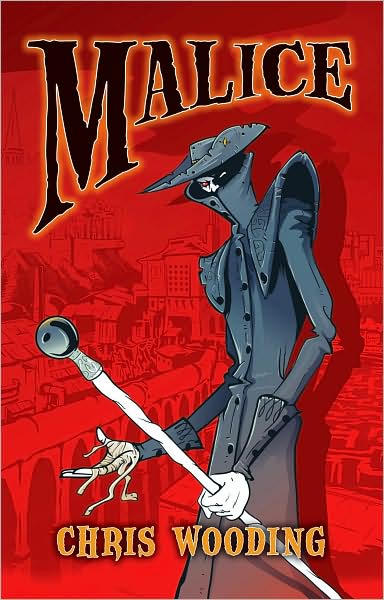
MALICE by Chris Wooding
4Q, 3P; J/S

Kids are going missing. Sometimes they show up again weeks or months later, but they can't remember where they were or what they did. The police and their parents are baffled. If they knew about the existence of Malice, their questions might be answered. What is Malice? It's a really creepy comic book set in a place called Malice. In its pages, kids fight for survival against strange, terrible creatures. But it's not just a story. Malice is a real place, and everything in Malice is real. You won't find Malice in most comic book shops, and most shopkeepers will claim they have no idea it even exists. But if you're really determined, you can get your hands on a copy. You might even be tempted to go to Malice, to have a few adventures yourself. You might be tempted to gather the materials and perform the ritual that will get you there: "Tall Jake, take me away! Tall Jake, take me away!".... But you'd almost certainly regret it.

Luke is one of the kids who disappeared. Only three people know that Luke had a copy of Malice. Only they know that he did the ritual. Only they know that Tall Jake did take Luke away to Malice. Only they know that Luke isn't coming back. How do they know? Because they saw him die in the pages of the comic book.

But is it really true? Is Luke really dead? Seth is determined to find out. He knows it's dangerous, but he's always hated the dull, predictable life his parents lead, and he's always been afraid he'll wind up just like them. He's always liked to push the edge and get the thrill that comes when you're really up against it. What better place to do that than a place like Malice, where there's no room for error and your life is always on the line? Seth too does the ritual ("Tall Jake, take me away...") and becomes one of the missing kids. Within minutes of his arrival, he has narrowly escaped his own death and witnessed another's at the hands of one of the vicious mechanical inhabitants of Malice. It only gets worse from there.

Left behind by Seth, Kady sets off on her own quest to get to the truth. Her search leads her into just as much danger as anything she'd find in Malice. Because what Kady finds are the people deeply, evilly connected to Malice. And they know who she is and where she lives.

Their search for answers leave Seth and Kady staring death in the face and the readers of Malice on the edge of their seats.

Musings:

The decision to tell this story partly in prose format and partly in graphic novel format was brilliant. Each time the story moves to events in Malice, the book shifts into graphic novel mode. In effect, the reader takes on the role of one of the readers of Malice (the comic book) who is watching the events unfold before his eyes. It takes the reading experience to a different level.

In the past, I've had a hard time getting into Chris Wooding's books. I don't think that had a thing to do with the author. The books just weren't right for me. I found this story to be a more comfortable fit, though a book this dark is certainly far from a comfortable read. I was intrigued by the premise.
I thought Wooding did a particularly good job creating the aura of Malice. Its bleakness and hopelessness is emphatically punctuated by bursts of terror and rushes of adrenaline. I'd never want to go there, but I can understand its appeal to someone like Seth or Justin.

I am not skilled at reading graphic novels, which meant that I occasionally had some trouble interpreting what was happening in the illustrated portions. That was somewhat frustrating for me, but I think the majority of the target audience is more familiar with the format and will have less trouble.

As well-developed as parts of the novel are, I do have some quibbles with it. The role of the various villains and how they are connected to each other is very murky. There doesn't appear to be any particular reason for their actions, and even a bad guy ought to be given some motivation for doing the things he does.
As Tall Jake makes clear on the last page of the book, he will be back in a sequel soon, so I expect the holes will be filled in a bit then. But while it's true that when a book is intended to be a part of a series there have to be things you still want to know at the end of the first book, it 's also true that the book should still be complete unto itself. I think Malice falls a bit short in that department.

I will recommend this book to readers who like dark, atmospheric books, graphic novels, and suspense, and readers who don't mind unanswered questions.


Friday, July 17, 2009

Creepy, Creepy, Creepy

Frozen Fire by Tim Bowler
4.5Q 3P; Audience: J/S

Frozen Fire is creepy and atmospheric and had me completely engrossed. On a hot summer night, I got chills, and not just because of the suspense. You can almost feel the cold and the snow.

Imagine being alone in the house and getting a phone call (your number is unlisted) from a voice you don't recognize. The voice says, "I'm dying." The boy on the other end of the line sounds about your own age, maybe a year or two older. His voice is slurred and angry. He calls himself Josh. Your brother's name. Your missing brother's name. He's not your brother. But he knows things about you he should have no way of knowing. Creepy, right? Who is this boy? Why did he call her? What does he want?


He says he wants to die. But he can't die. Not yet. Not before he tells Dusty what he knows about Josh. He must know something about him. Why else would he have given her that name? How else would he know her secret nickname? How else would he know what Josh's last words to her were?

When Dusty rushes out into the snowy New Year's Eve night to find the boy, she discovers she's not the only one looking for him. Three vicious men with their equally vicious dogs are also after him. They threaten and terrify her. But they are all stymied in their attempts to find the boy. He has disappeared, literally without a trace. How could he have left no footprints in the snow?

Various people spot a mysterious figure on the paths, up in the mountains, and in and around town. The word is out: this boy is dangerous. He's responsible for horrible crimes. Stay away from him at all costs.

But Dusty can't stay away from him. How could she, knowing that he has the answers she's been desperate to find for so long? She finds him. Now she's more frightened than ever.

This isn't quite fantasy, and it's not supernatural, exactly, either. It's a blend of both, with suspense and mystery thrown in. It may not be everyone's cup of tea (some readers will be discomfited by some of the ambiguity and the British slang and style), but it's expertly told and a great choice for readers who like to be kept on edge. Readers may also want to look for Bowler's Storm Catchers. Bowler's books, including Frozen Fire, have won several awards in England.

Tuesday, June 23, 2009

The Plague! The Plague! Someone Save Us!

The Comet's Curse by Dom Testa
3Q 3P; Audience: M/J


When the comet Bhaktul flits through Earth's atmosphere, it leaves universally fatal death-dealing particles behind. It won't be long until everyone is dead. Is there any chance that a cure will be found before that happens? Is there any chance the civilization can be saved? With the scientists and doctors dying, it looks unlikely. But Dr. Wallace Zimmer isn't willing to take no for an answer to either question. The virus doesn't affect people until they turn eighteen. If he can put together the right group of kids and get them away from Earth, perhaps they'll be able to find the way to defeat the virus and Earth's civilization. After an intensive search and training period, 251 of Earth's brightest teenagers are sent into space to colonize Eos, a new planet. It will take years for them to arrive and create a new life for themselves. But if they make it, they'll have beaten Bhaktul and Earth will, in some way, have survived.

The crew is carefully chosen for their intelligence, physical fitness, and emotional stability. They are carefully and rigorously trained for the formidable task ahead of them. The Galahad has everything they will need for a long space voyage, including farming facilities, living areas, and game and training rooms to keep them physically fit. And they have Roc, their walking (well, almost), talking, wisecracking supercomputer. Yes, they're young. But they're well prepared, brilliant, and ready for anything. Except, perhaps for the stowaway who is threatening to scuttle their mission before they've had a chance to truly begin it.

Musings:

I wanted to like this book, which is the first in the Galahad series. I was prepared to accept the improbability of a bunch of kids being the saviors of civilization. If it's done well, that premise can be exciting reading. But this is not done particularly well. The characters show some promise, but they are not yet fully developed. The story plays out predictably. The identity of the stowaway is not much of a surprise. But my major issue with the book is the lack of subtlety in the writing. For instance, Testa takes great pains to make sure his readers know that the crew is made up of teens of every ethnicity and culture. Here he introduces Gap, one of the five teens who make up the ship's governing council:


Gap thought of his early childhood in China, raised as an only child by his parents, both of whom were college professors. An early interest in gymnastics was fueled by his training with a former Olympic champion...[Then his parents relocated the family to America] And although his parents were concerned about the abrupt change in his life, Gap immediately accepted the challenge of meeting new people and forming new friendships. It seemed everyone warmed to him as soon as they met him...his school grades reflected his obvious intellect. He kept up his training with gymnastics, keeping an eye on that Olympic future.


Okay, we get it. Gap's Chinese, athletic, very intelligent, and very likeable. All of that could have been shown to us instead of told so bluntly. With Lita, the teen in charge of the infirmary, Testa first goes out of his way to tell us her ethnicity, but then he slips the same information in much more naturally. Which is more effective?

"Lita's black eyes and Latin American skin spoke of her upbringing in Mexico."
or, just a few pages later: "her eyes focused on a glass cube that sat atop a folder. The cube was filled with sand and small pebbles, one of the personal items from her home near the beach in Mexico."

Similarly, Testa works awfully hard to make us find Roc amusing:

I, on the other hand, will continue to be the same sophisticated, charming, and witty intellect that I've always been...I've got reserves of charm that I probably won't begin to tap for years. You're very lucky to know me. Don't you feel lucky?
and
...I obviously talk to the crew, I run the life-support systems on the ship, I answer questions, and I have a lovely singing voice. If you're a girl, and I'm a flesh-and-blood boy, you're all over me... You and I have the same information, so we'll both have to puzzle it out. The only difference is that I'm incredibly smart. Not that you aren't, but when you can recite the table of elements in twenty-six languages, get back to me.
I wish he'd just relax and let his characters be instead of having his author's voice be so intrusive.

I do think this series has the potential to be an intriguing read for younger teens who enjoy science fiction. I'm curious to see what Testa has in mind as the trip goes on and the kids first have to decide if they want to keep the same Council leaders and if not, what the fallout to that decision might be and then (and especially) when they land on Eos and have to create their own civilization. Will they try to maintain what they know from Earth, or will they try to build something completely different? What difficulties will they face? And what will they find in those rooms in the storage areas that are so mysteriously locked for the duration of the voyage? And of course, we already have a budding romance and a brooding leader who may spell trouble. What sort of fireworks will result from all that? Will they be the sort that inspire a satisfied "ahhh!" or the kind that makes one run for cover?

Tuesday, December 02, 2008

Another Reading Roundup

I've got five books on my pile to write up, and two of them have been waiting for two or three weeks. So I'm just going to put up a couple of quick impressions about a couple of them, just to clear the pile a bit.


Bonechiller by Graham McNamee
4Q 4P; Audience: M/J/S


I love booktalking Acceleration, and although it's a very different kind of book, Hate You is also a powerful read. So I've been waiting for a new McNamee book for years. Though this one didn't captivate me as much, it was still worth the wait. McNamee always tells a great story, and there's always more to it than just what's on the surface.

Ever since his mother died, Danny and his father have been moving from place to place, trying to escape their memories. In cold, desolate Harvest Cove, Danny winds up trying to escape from more than that. Deep in the most isolated reaches of Canada, this small Army outpost town holds a terror that most people don't even realize exists. Danny encounters it on a night that was already unsettling: he has just witnessed an arson/murder. His mind reeling and his nerves already taut as he walks home in the pitch dark, it takes him a little while to realize that he's being followed. At first it's just a feeling. Then he catches something (but what?) out of the corner of his eye. Maybe it's just a plastic bag blowing in the wind. Maybe it's just a dog. He tries to shrug it off. But then he hears the growl. It's a growl so deep it hurts his ears. And then he sees it. This is no plastic bag, no dog. But whatever it is, it's big. And it's fast. It is, in fact, a huge beast right out of legend, with teeth and claws eight inches long. Danny is sure he's a goner when he falls into a ditch and the beast catches up to him. But no - - the only mark he has to show for his meeting with the beast is a blue dot on the back of his hand. A fang mark? As the days go by, Danny realizes that no, the blue dot isn't the only mark the beast has left on him. His body temperature drops and he can always feel the beast watching and calling him. He can't sleep. The beast has invaded his dreams. He knows the beast will be the end of him. It's just a question of when.

Danny is not the only teen affected. One boy in their community has already succumbed to the call of the beast. Danny's friend Howie has also been bitten, and his symptoms are even worse than Danny's. Danny, Howie, Howie's psycho brother Pike (the aforementioned arsonist), and Danny's girlfriend Ash need to know what's going on. A little research reveals that dozens of local teens have disappeared over the years. Though common wisdom has it that they were runaways, the details point toward something else entirely, something that Danny and Howie know all too well. The beast has been luring teens to their death for thousands of years. What are the odds that Danny and Howie will break the cycle? 1000-1?

McNamee generally builds the tension well. Some readers may be irritated when the focus switches from Danny's present to Danny's memories of his mother and how her absence has affected his life. Others will recognize that these sections add to Danny's sense of isolation and that the emotional coldness he's been left with mirrors his physical coldness. Most readers will also appreciate the relationship between Danny and Ash, especially as it often adds a welcome note of humor that breaks the tension. In the beginning, much is made of Pike's mental stability or lack thereof, so I expected it to play a bigger role in the story and for things to play out a little differently as a result. Despite any quibbles I may have, I think Bonechiller will be popular, particularly with teenage boys. It's a book best read straight through, preferably with a warm blanket wrapped around you.

Tuesday, August 26, 2008

Reading Roundup, Part Two

Here are a couple of books I had high hopes for when I started them. Unfortunately, I think neither of them quite holds up to their early promise. But your mileage may vary.

The Chaos Code by Justin Richards
3Q 3P; Audience: M/J

When Matt Stribling's mother breaks the news to him that he's going to be spending his vacation with his father, rather than at home with her, he's not happy. His dad is a nice guy, but he's so busy with his archaeological work that he barely pays attention to Matt. Sure enough, when Matt arrives at the train station, Dad's not there. But Dad's not at home, either, and little by little, Matt comes to the conclusion that something is seriously wrong. Maybe it's the mess (but Dad's place is always a mess). Maybe it's the sandy footprints leading through Dad's office and out onto the lawn. Maybe it's the rough, sandy fingers he feels closing over his face and cutting off his air until he passes out. Or maybe it's the missing mail that was on the floor when he arrived and wasn't there just a few hours later. Or maybe it's the coded letter from his father, telling him to go to his Aunt Jane's and to worry if he doesn't hear from him soon. Or maybe it's all of the above.

When Matt heads to his Aunt Jane's, he has no idea that he will soon be meeting some of the richest and most ruthless men in the world, or that he will soon be swept up in an adventure that will find him in remote jungles and ancient pyramids, and threatened by advanced technology he couldn't have imagined existed. He isn't facing these things alone, of course. Aunt Jane works for multimillionaire collector Julius Venture, and Venture has a daughter, Robin. They are just the kind of people you want on your side when things get tense. But that doesn't mean that Venture and Robin don't have significant secrets of their own. Can Matt and Robin stop what seems inevitable? They hope so, because the fate of the entire world depends on their doing just that.

I was hoping that the book would continue in the same vein in which it started, with Matt having to decode various puzzles and clues as he gets closer and closer to discovering what happened to his father. Instead, the book is more of a cat-and-mouse game, with lots of action (which is a good thing) and chases. But I felt the whys and hows of what was going on got muddled. It felt as though the author hoped that if he threw enough things into the pot, his readers wouldn't really notice that the recipe isn't quite as filling as it ought to be. I had a few too many "Didn't you already say that?" and "I didn't quite get what you were going for there" moments as I read. I'd also have appreciated a more nuanced villain and fewer lucky coincidences. But perhaps that's just me. Readers who like a lot of action and suspense may not care or notice those things as much as I did.


Bunker 10 by J. A. Henderson
3Q 3P; Audience: J


At 2000 hours on Monday, 24 December 2007, Pinewood Military Installation exploded. The blast ripped apart acres of forest and devastated the remote highland valley where the base was located. There were no survivors and no official cause was given for the incident. Inside Pinewood were 185 male and female military personnel -- a mix of scientists and soldiers. There were also 7 children. This is the story of their last day.


Okay, a story can't open with much more of a grabber than that.

Pinewood is a secret military installation. Very few people know what goes on there, and even fewer people know that the seven children in the installation aren't ordinary kids. Each of them is a genius, and each has an ability that the army prizes highly. As a result, they have each been conned, coerced, or invited to work at Pinewood, with the understanding that they will join the military when they turn eighteen. In the meantime, they study, work on their own special projects (time travel is a big draw), and follow the dictates of those in command. Those officers haven't gone out of their way to make the school particularly comfortable or welcoming to the kids. That they aren't allowed to go home for Christmas is a pretty good indication that their choice to come to Pinewood wasn't the best decision they ever made. The rules are strict, the barracks are barren, and their life is about their studies. Given the situation, it's not surprising that a couple of the kids are ready to break loose. All Jimmy and Leslie want is go on a simple date. Off campus. It's all fairly innocent, really, as far as treason goes.

Getting off the base involves jamming signals and locks (for these kids, that's child's play) and otherwise deceiving their military guards. What Jimmy, Lesley, and the other kids don't realize is that they aren't the only ones who have secret plans. Messing around with the security system might not have been such a great idea. The plans of the others are potentially a whole lot deadlier than sneaking out for a date.

Lieutenant Dunwoody and his special teams force are on their way to Pinewood. All Dunwoody knows is that he is being sent to a facility that specializes in advanced virtual reality technology (all the better to train soldiers in combat techniques) as well as things like three-dimensional mapping, biohazards, and alternative fuel resources. But those are not his concern. His concern is whatever is in the lower levels of Pinewood, an area so highly classified that nobody will tell him what it is he's about to encounter.

The third group prowling around Pinewood this Christmas Eve consists of Sherman, a virtual reality simulation specialist who works for the military; Madrid, a tall, athletic woman sent from High Command; Darren, a computers and electronics whiz kid; and Nulce. What does Nulce do? He kills people.

While Jimmy, Lesley, and the other kids are concentrating on their date, Dunwoody and Sherman's teams are about to learn about Bunker 10. What's in the super-secret Bunker 10? May-Rose. May-Rose used to be just one of the kids. Not anymore. May-Rose has...evolved. And if she breaks out of Bunker 10, the world is going to regret it. She must be stopped at all costs. At any cost.

Believe me, the costs are high (as if you couldn't tell, given how the book begins). This is a book for readers who like gore, violence, and mayhem. It also requires readers who have the patience for discussions about time travel, virtual reality, genetic manipulation and the like, as well as the ability to follow several storylines at once. One of the storylines has a neat little twist/premise that I don't want to spoil. Suffice it to say that it will leave you wondering what's really going on. Some readers will like that. Some won't. One aspect of the book that I found problematical was a mention that each of the kids in the story supposedly have the traits of various despots of the past. I spent a fair amount of time trying to identify those traits and looking for similarities with Hitler, Stalin, Pol Pot, etc., but I wasn't successful. It bothered me that that was presented but not (or poorly) followed through. If it wasn't important to the story, why mention it? (I do have a guess about that, but I don't like that answer.) If it was important, why wasn't it more developed? I was bothered even more (because it's constant) by the jive talking of Dave, one of the teens. I found it utterly unconvincing and increasingly irritating. I'm sure it was an attempt to individualize him, but the end result for me was a character that seemed fake rather than authentic. Other characters, including Lesley, May-Rose, and the colonel, are either barely developed or essentially play the same note throughout. Characterization is not the strong point of this novel.

Ultimately, I found Bunker 10 disappointing. It has an intriguing premise and a terrific start. Henderson is excellent at ratcheting up the tension and keeping the action going. But I found the parts more coherent than the whole, with the "what it's all about" ultimately confusing and unconvincing. However, readers who like a thrill ride of a read may be willing to overlook things that I could not.

Monday, April 21, 2008

So, What's Your Secret?

The Black Book of Secrets by F. E. Higgins
4Q/4P M

My library has this in its children's collection (which technically is for Pre-K to grade 6), but I think it's more a middle school (grades 5-8) book. I finished the book while in bed. Just before I fell asleep, I wrote a one-paragraph summary I really liked. But it was all in my head, and naturally, I can't remember a word of it now! But as I said in a previous post, because I read this while on leave, I'm confining my review to just a short summary and a reaction paragraph.

When Ludlow realizes that his drunkard parents intend to have his (perfectly good) teeth pulled out so they can earn a few pence for more drink, it's the last straw. He's determined to get out of their clutches for once and for all. He escapes his squalid life by catching on to the back of a coach
leaving the city. The coach belongs to a despicable man named Jeremiah Ratchet, and its destination is the small village of Pagus Parvus. Ratchet has made the lives of the villagers miserable by sucking them dry of nearly every penny they earn. After stealing Ratchet's scarf and mittens, Joe meanders up the hill, where he discovers that he is not the only newcomer. Joe Zabbidou has also just arrived in town. He intends to open a pawn shop in a building on the outskirts of the village. Joe welcomes Ludlow in. In fact, Joe is a very welcoming sort. He takes all sorts of things in trade, even the most worthless (a chipped chamber pot, anyone?). But every now and then, Joe will look at a customer and ask if he'd like to stop by for a visit later in the day...say about midnight? And when they come (as they always do), Joe greets them with a drink and a question: Do they have a secret they'd like to share? They do, always. And they are dark secrets, involving murders, grave robbing, thievery, and the like. It is Ludlow's job to record these secrets in Joe's black book of secrets. It becomes clear that the villagers hope that Joe, who has helped them in so many other ways, will also help them deal with Ratchet, but Joe steadfastly refuses to do so. Ludlow can only watch and wonder what Joe's intentions are. What does he do with the secrets he records? He pays handsomely for those secrets, but where does the money come from? And if he doesn't intend to help the villagers, why is he there?

This is an entertaining read, and I think it will get good word of mouth. But the imagery is vivid, and kids who are squeamish or prone to overactive imaginations may find it disturbing in spots. On the flip side, kids who like dark, creepy books will love the more sinister, grosser aspects of it. Higgins balances the dark with a tendency to go slightly over the top at times, especially with Ratchet, so just when things might be getting a little too horrific, there's a passage that can't be taken too seriously to lighten things up again. Ludlow is an appealing character, and Joe is an intriguing blend of mystery and simple(?) goodness. Higgins's ability to build tension worked for me as a reader, but also as a key plot element as the villagers get restless waiting for Joe's hatchet (so to speak) to fall on Ratchet. The ending is a bit of a stretch, but with the exception of one element of it, not surprising. After all, with books like this, it's pretty much a given that there's a book two in the works. Will I read the next one? It's not going to be on the top of my list, but I wouldn't be surprised if I checked it out at some point.

Tuesday, February 26, 2008

Tamar: Appearance vs Reality

Tamar by Mal Peet
4Q 2P    S


I usually try to do an overview of a book and then write about my impressions. But 1) I read this book several weeks ago and details are starting to fade, 2) what I started to write was dull, and 3) cutting to the chase (well, as much as I ever do!) feels right.

When I finally got my hands on Tamar, I only had three days to read it and Dreamquake, because I was trying to finish them in time to cast a vote for the JHunt Award. They're both over 400 pages, and I wondered how I could possibly do it. But Tamar was compulsively readable. How could I not get wrapped up in the story of two young men working with the Dutch Resistance in service to the British Army? How could I not get invested in a love triangle between those two men and the Dutch woman they both secretly love? How could my stomach not tie up in knots at the danger these three faced? The tension of these situations kept me riveted as I read.

Tamar's assignment is to gather the various factions of the Dutch Resistance and get them to work together under one leader with one common goal. Dart is his radio man. Tamar has the advantage of living in a farmhouse with his lover and her grandmother. Dart has a less cozy cover story, posing as a doctor in a local psychiatric hospital. Peet is a master of building and relieving tension. While it's obvious that anyone working in the Resistance must have led a life of constant stress and fear, I had no idea how nerve wracking it was to be a radioman in particular, or about how many of them became dependent on pharmaceuticals as a result of having to deal with long stretches of tedium interrupted by minutes of sheer terror. Just reading about Dart's first attempt to get past the Nazi soldiers guarding the gates into town had my heart racing along with his. My stomach was in knots later in the story when the moment he's feared for so long actually arrives. By comparison, Tamar seems to have it good. Networking and diplomacy aren't the beacons for the Nazis that turning on a radio signal is, so although he must be careful, his chances of being caught by the Nazis while doing his job are not as high as they are for Dart. And he has Marijke, his lover, to turn to. So when the story turns to them, we get a different view of Resistance work. We see the methodical, longterm planning and experience the frustration of trying to bind together people who don't want to be melded into one. We also see more of the privations that people in occupied territories faced. But we also get a love story. This is an adult love affair, told from an adult perspective. Having been separated once before, Tamar and Marijke cherish each other all the more. But they must be circumspect about their love. To the outside world, Tamar must appear to be no more than a laborer for the family. Tamar also fears that their partnership would be weakened if Dart learns about his love for Marijke. So this is one more secret for him to hide on top of all the others they must keep.

The secrets and the stress that we witness in the WWII sequences come home with a vengeance almost fifty years later, starting with Tamar's suicide. Before he jumps naked from his balcony, he leaves something behind for his granddaughter, also named Tamar. It is a box, one that she refuses to open for months afterward. When she finally does open it, it turns out to be a Pandora's box of sorts - all sorts of secrets come out as a result.

I've heard some complaints that the 1995 sections of the book are less compelling than those that take place during the war, and I can't disagree. They are slower, and the romance angle of it didn't work for me. But I also felt that they gave the book more context and more richness. This is a story that demands that some insight into how actions and decisions of the past impact the future.

Tamar is very much about
what seems to be isn't always what is, so it shouldn't be all that surprising that there's even debate about who this book is written for and who it will appeal to. Tamar tells two stories. The one that is most compelling and which takes up the majority of the book does not feature a teenage character. Because YA literature by most definitions must feature a teenage character in an integral role, some are questioning whether this is adult fiction or YA fiction. Good question. I think this is a book that has appeal for both adults and teens, and I think it would be very interesting to hear the discussion if a group of adults and teens read the book and got together to share their thoughts on it. But it's also fair to say that this is probably not a book that is going to be widely and hugely popular among teens. It's a niche book. Teens who like to read books about other teens and don't like historical fiction may not be able to relate to Tamar-the-younger enough to find this book appealing. But teens who like war and espionage stories, romance intertwined with danger, and stories that take their time in the telling are going to relish the time they spend with it.

Monday, February 11, 2008

When Is a Joyride Not a Joy?

Okay...this was written in August and never posted, apparently. Since it's been two weeks since I posted anything other than a stop-gap post, I'm going to go ahead and publish this even though I must have wanted to edit it or add another thought. Since I have no idea what I had in mind, there's no point in waiting any longer.

TWOC: Taken Without Owner's Consent by Graham Joyce
4Q 3P S

Matt’s having a hellish time. He’s on probation and seeing a court-mandated counselor/probation officer. It’s not unusual for him to wake up screaming from horrible nightmares. And during the day, he’s haunted by the mocking image of his brother Josh, who died over a year ago. Matt taught Josh everything he ever needed to know about TWOCing – stealing cars to go joyriding. What Matt would like to forget, but can’t, is the horrible night he, Josh, and Josh’s girlfriend went on a terrible joyride that ended with Josh dead and Jools (the girlfriend) horribly disfigured. Only Matt walked away from the crash seemingly unscathed. But with those nightmares, strange memory lapses, and seeing Josh outside every window, Matt’s only unmarked on the outside. Inside, he’s a mess.
Matt’s parole officer offers him the chance to participate in a weekend Outward Bound-type program that will, if he finishes it successfully, reduce his probation time. They'll be rock climbing, hiking, and (::sigh::) participating in group discussions "in a spirit of openness and honesty". Matt's not the outdoors type, and he's not convinced that this is anything he wants to do, but he's not really given that much of a choice. He has two companions on this trip. Gilb's a quiet kid with horrible acne ("even his zits have zits"), spiked, henna-dyed hair, and a vacant look ("he has a look about him, like someone removed the front part of his brain"). He's also a graffiti whiz, which Amy, the third companion, thinks is pretty cool. (They've both seen his work, and he's good.) Amy's a much bolder personality. Her hair is so short, you can see all the cuts on her scalp ("it looks as though she tried to cut her own hair with long-handled tree-pruning shears". Later she sports a multi-colored mohawk.) She's a fan of army-surplus clothes, and heavy goth-type makeup. She's also an in-your-face kind of girl who doesn't take any guff from anyone, least of all Matt. Amy's prone to setting fires where they don't belong. It probably won't surprise anyone to learn that this weekend trip is a big turning point in Matt's life. He learns a lot about himself over those two days, and some of it is stuff he'd really rather not have discovered. It also probably won't surprise anyone when Matt winds up bonding with Amy and Gilb. But Graham Joyce takes his readers on a heck of a ride (in more ways than one - this is, after all, a book about a kid who likes to go joyriding!) while Matt is on that journey of discovery. I'm pretty sure that even teens who don't really get into books will find themselves holding on for dear life when Matt, Amy, and Gilb break out of camp, steal a car, and take off on a joyride that starts out as a thrill and winds up in a place that gives Matt nightmares. This book is an interesting mix. It reads like realistic fiction, but the main character insists he is being haunted by the ghost of his dead brother. It has moments of action and suspense, but it also has many quieter scenes. Personally, I often found myself holding on to the edge of my seat (figuratively speaking) as I read, and I think I held my breath more than once. I also laughed far more than once. Matt, the main character, has a wicked sense of humor and he’s a very sarcastic observer. That makes for a fun read in between all the suspenseful and action-packed moments. But even with the humor and sarcasm, Graham Joyce never lets you forget that Matt is a very damaged kid who is dealing with a world of hurt. I cared about Matt, and he felt very real to me. Ultimately, I thought that Matt's problems and the book itself are resolved too neatly, and that the development of the relationship between Matt, Gilb, and Amy was a little too quick and neat. Because of those factors, this book hovers between a 3 and a 4 in quality for me, but I went with the four because the voice is so consistently strong and I found the storyline compelling. I wasn't sure where Matt's story was going, even though other aspects of the book were more predictable. British terms and slang are used throughout. That’s usually not a problem for me, but this time, I did get puzzled by a few terms. I wish I’d known that there was a glossary in the back. It would have helped. A couple of the terms I wasn’t familiar with turned out to be slang for part of the male anatomy. Others were sport-related terms that may or may not be specifically British. I was familiar with other terms from other books, but if you haven't read a lot of books written by British authors, you'll want to look at the glossary first.

Quotes:

A few lines from the book, chosen to give you an idea of Matt's voice:


(Sarah, Matt's probation officer/counselor, who is pretty hot:) "You seem so distracted, Matt. I wish you'd tell me what's going on in that head of yours."
Is she winding me up? If she can cross her legs like that and not know what's going on in the head of a sixteen-year-old boy, I don't think she's much of a probation officer.

A taste of Matt's day/nightmares. Jake has just handed Matt a bag, telling him he's too thin:
But I don't know about this bag. It has a bad weight. I open the bag, reach in, and pull out some of its contents. In my hand is a human ear, slightly ragged and bloody at its edge. And a toe. And a finger amputated at the second knuckle....I glance up from the bag and there is Jake outside the window laughing his head off, and in my hand are these body parts and I start screaming loud, louder. I start screaming and I don't stop even though no one downstairs can hear me because Slay Dog Dog are laying down some really heavy chords and screaming vocals themselves. But then the track reaches its end and I'm still screaming when my dad bursts into the room...."It's all right son, it's all right," he says, taking a bag of biscuits out of my hand.
Matt talks about learning how to break into and hotwire cars from his brother. At one point, he explains that they didn't always steal the cars. Half the fun was in seeing how fast they could break into a car. Sometimes, just for fun, they'd leave their business card for the owners:
"Your car was checked today by the NEIGHBOURHOOD WATCH SCHEME. It took only (blank) seconds to enter your car and poke around the glove compartment, where we found (blank - we would write things like "condom," "G-string,", etc. in this space). Please take greater care in the future and have a nice day. With the blanks neatly filled in, we would leave the car on the seat for the driver to find. We even did a police car once. You're dying to ask, aren't you? Thirty-nine seconds.
Matt's not too impressed with the conditions at the camp. The food in particular is less than inspiring. And this royal feast, this banquet for kings, is garnished with a sprinkling of green plastic-toy frogspawn, which on closer inspection proves to be tiny bullet-hard peas, boiled to death for God-knows-what crimes against humanity. And I'm not going to quote anything from this, but I'll tell you that the horse riding scene is one of my favorites in the book.


In the time since I wrote this, I can see that the 3P rating seems pretty accurate. But that's how it does just by sitting on my New Books shelf. I think it would sell pretty well in formal/informal booktalking situation (I may test that this week!).

Friday, January 04, 2008

Reading Roundup, Part One

I am so far behind on posting about books I've read recently (as in, anywhere from five weeks to five days ago) that I'm just going to do a quick write-and-run on several of them in one or two posts. If I try really, really hard, I can do this in two paragraphs or less per book. (Gee, there's a game show in that somewhere: "I can write that blog review in 100 words or less. No, I can write it in ninety words or less." "Reading Fool, write that review!" Oh, who am I kidding? 100 words or less? Maybe a 100 lines or less!)


Diamonds in the Shadows by Caroline Cooney
3Q 4P M/J/S

The Finch family is playing host to a family of refugees from Africa, and Jared is not happy about it. He particularly doesn't like having to share his room and his life with the teenage boy, Mattu. But that soon becomes just background noise to all the other things going on: How can the father, Andre, get a job, when he has no hands? And why doesn't he have hands? Why do Andre and Celeste ignore Alake, their daughter? And why doesn't Alake speak or even look at anyone? What does Mattu have in that box he carries around? Is it really just ashes? And how come this family doesn't act like any other family Jared's ever seen? Nobody else seems to be thinking about any of this. Jared's sister, Mopsy, is delighted to have a sister to take under her wing, and Jared's mother is in her element helping the family get settled in America. But Jared's father is so preoccupied with embezzlement from a fund he was responsible for he barely comes home anymore, and when he is home, he isn't paying attention. Jared feels that he's the only person in his family who is seeing the situation with clear eyes. But Jared doesn't know the half of it. In particular, he doesn't know that there was a fifth African refugee on the plane. And he doesn't know that the Amabo family has something that that refugee wants very, very badly. And though he heard the Refugee Aid Society representative say, "In a civil war, there are no good guys," he can't begin to imagine what that really means until the truth begins to come out. When that happens, Jared's indifference and frustration turn from shock to horror to terror.

Cooney knows how to get her readers' attention and keep it. And without being too graphic, she makes clear the horrors so many people in Rwanda, Sierra Leone, and too many other places in Africa have experienced in recent years. She makes you feel for her characters, even when you don't necessarily like or admire them. However, I did find some aspects of the story a little hard to swallow. In particular, I don't for a minute believe that the adults (especially Mom) would overlook the signs that something is strange about the Amabo family, especially when the kids pick up on it almost immediately. (Conveniently, they then seem to forget it until the climax.) But I am willing to overlook that and a few other things because this is a book that puts events of global importance into a situation and words that teens can relate to without being overly preachy and without sacrificing tension and drama.


My Life, the Musical
by Maryrose Wood (Advance Reader's Copy)
3Q 4P M/J/S

"There's No Business Like Show Business" Annie Get Your Gun, music and lyrics by Irving Berlin, book by Herbert and Dorothy Fields. Emily and Philip are best friends. Their friendship began in the line for the first preview performance of the soon-to-be smash hit Broadway show Aurora. Both were blown away by the show, and as a result, every Saturday morning for the past three years, they've taken the train to New York City to stand on the rush line to buy two tickets to the show. Over the years, they've gotten to know Ian, an aspiring actor, Stephanie, one of the dancers in the show, and all the other regulars on the rush line. Even Marlena Ortiz, the star, knows who they are. Their lives revolve around Aurora. Every English essay Emily writes is about Aurora. Philip keeps extensive spreadsheets on every possible aspect of the show. They even have their own Aurora chat room. They know every word and every note of the show. So they are naturally devastated one Saturday morning when Ian reports that he has it on good authority that Aurora is about to close. How can that be? It's still playing to packed houses! But one of their rush line cohorts soon sets them straight. The person Ian heard the rumor from is full of baloney and always has been. The show isn't closing. Whew! Except...the rumor is true. The show is closing. It's shocking! It's a tragedy! It's ...imperative that they see every single performance they can possibly afford to see from here until the ::sob:: end.

Intertwined with all that drama is more drama. There's the mystery of who wrote Aurora - the book writer/composer/lyricist has never revealed who s/he is, not even when the show won multiple Tony Awards. Then there's the problem of how to afford tickets to a Broadway show every week without committing a felony and the problem of how to appease your English teacher, who is sick to death of hearing about Aurora this and Aurora that. And then there's the problem of what to do about an absentee mother and a jerk of a brother who insists that you're gay. Yeah. That's drama.

This is the kind of book I wanted to read as a teenager. It's a book for every kid who has ever fallen in love with theater, whether they want to be the star, the stage manager, or the devoted fan. Even better, it's written by someone who has been there, done that. (I got the ARC by correctly answering the question "What cult musical did I [the author] appear in on Broadway?" A quick web search turned up the answer, and it was pretty cool to find out that we had a mutual acquaintance, since someone I knew was in the show too.) Do I think the book is a little over the top? Yes. But I wasn't reading it for realism. I was reading it for fun, and I got that in spades. I'm also glad that I got faked out a couple of times, since it's nice when you can't correctly predict everything that's going to happen in a book. In particular, I appreciated that the ending leaves a couple of things undecided. Life is like that, but books rarely are. And it's a fun conceit to have the chapter titles be apropos titles of songs from various Broadway musicals.

(So much for keeping it to two paragraphs!)

Tuesday, October 30, 2007

Silence is Not Golden

The Silenced by James Devita
4Q 3P/ J S


Wow. I just finished this book and even though I have two other books I should be writing about first, I need to write something about this one now, while the feelings are still fresh.

Wow. Talk about an atmospheric book. There are some books you don't want to stop reading because they're so good. There are some books you have to stop reading, even if you don't want to, just to give yourself a chance to breathe and your heart to stop pounding. I put this book down at least six times because I needed a break. I couldn't stand the tension or the fear of what I thought/knew was coming. I needed to do something mindless for a while, so that I could give myself a chance to process what I'd read and what was coming.

No long summary here. In a nutshell, this book takes place in an unspecified future time in an unspecified country (but I still read it as the U.S., though that may be U.S.-centric of me). A war was fought within recent memory, and the Zero Tolerance party is now in power. We're not talking about zero tolerance for teasing, or zero tolerance for drugs, or zero tolerance for weapons in the schools. We're talking about zero tolerance for tolerance. Zero tolerance for individual thought. Zero tolerance for different religious beliefs. Zero tolerance for deviation from the official government line. Zero tolerance for different. In the initial phases of the new government, many of those who fought or protested were "neutralized" - government-speak for killed. But it wasn't enough to hold those people responsible for their actions. Their families are held responsible as well. The families have been sent to readaptation communities all around the country. Suspect spouses are put on house arrest, while the children are re-educated in schools that are nothing more than indoctrination facilities.

Marena is one of those children. She only has brief flashes of memory of what happened the night her mother was taken, but she can remember what her mother believed. And one of the things her mother believed was that you do not have the right to stay silent when evil is happening around you. Marena is already resisting in as many ways as she can: she mouths the words of the anthem and the loyalty oaths they are forced to repeat, she refuses to give up her precious paper, pens, and papers when writing implements are outlawed, and she refuses to believe what she is told to believe. But when a favorite teacher is taken away and a new and stricter administration is brought it, Marena knows that it's time to take a harder stand. She convinces her would-be boyfriend Dex and the new boy, Eric, that it's time to actively rebel. They slash tires. They vandalize the school with slogans. They spread leaflets. They spread the word: The White Rose will not be silent. But their rebellion comes at a very high cost.

Any similarities to the Nazi regime are completely intentional. This book is a tribute to Sophie Scholl, her brother, and the other members of the White Rose resistance group, who fought the Nazis with pamphlets, leaflets, and graffiti, spreading the idea of resistance throughout their university and beyond. It's also, I think, a protest against the people in our own country right now who insist that voicing objections to actions of our political leaders is nothing short of traitorous. But if the people don't remind their government to have a conscience, then we open ourselves to nightmare scenarios. Sophie Scholl, Nelson Mandela, and Marena could testify to that.

Lest I have made this sound like a book that only those of a political bent could enjoy, let me assure you, it is not. Despite its length, I think many teens who don't really like to read could get caught up in this one. Rebellious teens fighting against the authorities. Questions about who you can trust (can you even trust your own father?). Midnight trysts and post-midnight illegal actions. Short, cliff-hanger ending chapters. This is a compulsively readable book that will have many readers riveted to the last page.

Tuesday, August 14, 2007

Predator or Prey?

Tantalize by Cynthia Leitich Smith
3Q 5P J/S

Among the reviews I'm more or less giving up on (see previous post) is one on this book, which I had mixed feelings about. Interesting characters, intriguing setting (a vampire-themed restaurant in the middle of Texas?), a cup of murder, a dash or two of romance, a pinch of humor, and some seasonings you don't find in your typical recipe...I mean book!...those would seem to be the ingredients of a terrific read. It's gotten really good buzz on the blogs I read, but when I finished the book, I wasn't really sure how I felt about it. I'm still not sure. It's not so much a liked it/didn't like it dilemma. It left me feeling...unsettled, I guess, and a little creeped out. I've read other vampire/werewolf books and liked them, even though it's not my favorite genre, so that's not what got to me. This one had an element or two that made me more uncomfortable after I read it than while I was reading it, and I guess that's what's throwing me. Anyhow, I can't wait to hear what my patrons think of it, and if you're reading this and have read it, please tell me what you thought of it.

You can find information and other bloggers' thoughts about Tantalize

on the author's web site

and

on Required Reading (This site has a review of the book and a "Five Lists of Five" interview with Smith that I enjoyed reading. Gotta like her taste in vampires and authors!)

and

on Bookshelves of Doom

and

on Talking Teen Books

Monday, July 30, 2007

Too Smart for Anyone's Good

I've got a backlog of books to blog about, so I'm going to do some (hopefully) shorter posts about them to help myself catch up. Here's the first:

Evil Genius by Catherine Jinks
4Q 4P, J


Cadel Piggott is a genius. If you're astute and you've read the title of the book, you rightly assume that he is an evil genius. But it's not completely his fault. After all, what would you expect a kid to be when, after getting arrested for hacking into computers at the age of seven, he is brought to a child psychologist who tells him that his one big mistake was getting caught? As it turns out, the psychologist, Dr. Roth, is a bit of an evil genius himself. Or at least, he's evil, and he's the go-between for Cadel and another evil genius: Cadel's real father. Cadel's father, Dr. Phineas Darkkon, is in jail for various nefarious plans. But his biggest nefarious plan is one the authorities can't stop: he plans to educate and train people with superior abilities (like Cadel) and help them take over the world.

Over the years, Dr. Roth and Dr. Darkkon guide Cadel as he goes through school honing his talent for lying, manipulating, and plotting, as well as developing his computer hacking skills. (He uses all of these skills in developing an online dating service that winds up being significant for many reasons.) Finally, at the age of fourteen, he is ready to enroll in his father's Axis Institute to be trained in the arts necessary for world domination. His courses include Basic Lying, Pure Evil, Embezzlement, Contagion, and Assassination.

Up to this point, Cadel has had no problem with his father's plans for him. But the Axis Institute isn't for the faint of heart. Tortured screams echo the halls, classes are disrupted by deadly explosions, and blood frequently drips from the ceilings, fellow students die (horribly) or mysteriously disappear, and the faculty is deeply suspicious of each other and their students. Even for Cadel, it's all a bit too much and he begins to wonder if being an evil genius is all it's cracked up to be.

I'm going to recommend this one to kids who like the Eoin Colfer's Artemis Fowl books, with a few caveats. This one is a lot longer than those books, and it doesn't have as humorous a tone. But it does have a kid-as-criminal-mastermind theme, and the kid is every bit as interesting as Artemis is. I think it's more complex than the Artemis Fowl books, and it's certainly darker in tone and theme. I know elementary school kids like the Artemis Fowl books as much as middle school readers do, but I think Evil Genius is better suited to Artemis's older readers, as well as readers who don't mind a book where the action moves a little more slowly. I think I might also suggest this book to teens who have enjoyed Muchamore's C.H.E.R.U.B. books and Butcher's Spy Highseries. I've just read a few reviews that compare this book to Harry Potter, too, primarily because it involves a young boy who gets sent to a school to get trained to use his talents. I think this one has a different feel from Harry Potter, though I'm sure there will be some overlap in readers.

Monday, June 18, 2007

What's the buzz on this mosquito?

The Hand of the Devil by Dean Vincent Carter
3Q 4P J

Warning: If you are easily grossed out, think twice about reading this book. On the other hand, if your idea of a good time includes reading about decaying corpses and (very) bloodthirsty monsters, step into my parlor, said the mosquito to her next victim.

Ashley Reeves is a young journalist who works for a magazine called Missing Link. It's his job to investigate weird sightings of strange animals (among other strange things), even though they usually turn out to be hoaxes. He's not expecting anything different when he gets a letter in the mail from a man named Reginald Mather, who invites him to come see his specimen of the Ganges Red mosquito, claiming it is the only one of its kind. The letter seems genuine, and Ashley is intrigued. A few hairs on his neck do quiver a bit at a couple of things in the letter (why must he come so quickly? Why is he not to tell anyone?), but the story sounds too promising to pass up. He's on his way in hours.

Mather lives on Aries Island, so when Ashley arrives at the nearest train station to his destination, he must rent a boat to get to the island. The man he rents the boat from is an old crab, and the boat itself looks barely seaworthy. He's not a particularly expert boater, which is all the more a problem when a sudden fierce storm whips up as he crosses the lake to the island. He crashes the boat on a rock. It quickly starts to sink, and Ashley has to swim to shore. Almost as soon as he drags himself up on the beach, his cell phone rings. Once. Then it sputters and crackles and dies. Great. Now he has no boat to get home and no way to communicate with anyone off the island. If you think this is the kind of thing that should make him think "Bad omen! Go back!", you're right. But Ashley isn't thinking along those lines. Yet.

Mather turns out to be an odd sort of man. And is he really living alone on the island, as he says? Because as Ashley comes up to the house, he's sure he hears a female voice saying, "He's here!" But no, Mather swears he lives alone. He is a gracious enough host, offering to let Ashley stay the night and preparing some hot tea for him. But he is also strangely reluctant to let Ashley see the Ganges Red, telling him it isn't a good idea to disturb her after she's recently fed. Instead, he suggests that he read Her Story. The book is rather ghastly, featuring a series of stories about a fabled creature called The Devil's Hand. The illustrations feature a giant mosquito, quite large in size, attacking one or more screaming people, including Roman centurions, Saxon Britons, early Europeans, and various other cultures. Ashley can only hope that this Devil's Hand has nothing to do with the Ganges Red.

No such luck.

Over the next few days, Ashley will discover the following things:
  • The Ganges Red, or "The Lady", as Mather calls it/her, is a giant mosquito. Her wingspan alone is over eight inches.
  • Mather is rather desperate that he not explore the rest of the island or take any pictures
  • Mather seemingly has no intention of letting him off the island
  • Mather is quite, quite mad
  • The Lady is very, very hungry

I'm not kidding here. This book gave me the creeps more than once. Carter doesn't shy away from describing gross and truly horrific events, and sensitive readers should beware. He also does a great job building up the suspense. He's very good at the creepy moment/lull/creepy moment/lull/crescendo method of creating tension. Though at times some of the characterizations and dialog are a little over the top, it can be overlooked. Teens who have an itch to move past R.L. Stine will probably suck ever morsel of bloody horror from this book and savor it to the very last drop.

(Sorry. I couldn't resist.)

Wednesday, April 18, 2007

VM=Very Malignant? (Code Orange booktalk)

Code Orange by Caroline Cooney
3Q 4P J/S

Mitty prides himself on doing as little as he can in school. It’s not that he can’t do the work. It’s just that he doesn’t see the point. So when his advanced biology teacher assigns a term paper on an infectious disease, Mitty has no intention of doing any research for it. He figures he’ll grab a few facts off the Internet, paste them into a document, and he’ll be done. He actually forgets all about the assignment until the week before it’s due. That’s when he gets a punch right in the solar plexus: if he doesn’t get a passing grade on this paper, they’re going to kick him out of the class. Mitty could care less about advanced biology, but he cares a LOT that it’s his only class with Olivia. So he figures he’d better knuckle down and get some work done on the paper. And he means to. Really, he does. But it’s the weekend, so he deserves a day or two of rest, doesn’t he? By the time Mitty decides to get to work, it’s late on Sunday. He’s staying at his family’s place in the boondocks of Connecticut, and he realizes he hasn’t brought a thing with him for research. The library is closed and there isn’t a bookstore for miles around. And he needs books, since his bio teacher is waaay out of touch with the real world and won’t let them use the Internet. Mitty remembers that his mother just brought home a load of old books from an auction where they were selling off stuff from some old doctor’s house. Luckily for Mitty, the doctor had a couple of books on infectious diseases. As he starts to page through one of them, he finds a sealed envelope marked “VM – 1902” tucked between two of the pages. Inside it are a couple of scab-type things. The books are so dusty, Mitty starts to sneeze. One of the scabs crumbles in his fingers, disintegrating into dust.

It isn’t until a day or two later that Mitty realizes what he held in his hands: VM=variola major, otherwise known as smallpox, one of the most infectious diseases ever known to mankind. Millions died in agony from it. When Mitty sneezed, the scab that crumbled almost certainly got into his lungs. What if it contained active virus? What if he’s a walking time bomb, passing smallpox on to everyone he knows, including his parents and Olivia? Should he tell someone? But what if he’s not infected? He’ll look like a fool. What if he is infected and someone else finds out? What if that someone wants to infect thousands of people?

Saturday, November 18, 2006

WORDS ARE TEETH

What Happened to Cass McBride? by Gail Giles
5Q 5P S (language, violence)

"Sticks and stones may break your bones, but words can never hurt you." Bull. You know it and I know it. Words are powerful things. As a character in the book says, "Words are teeth". We all know that sometimes words hurt even more than a physical blow. Most of us have said things about someone and thought they'd never find out. Sometimes we've said whatever it was just to be funny. Sometimes we've said it just to be nasty. Sometimes we know we're being unkind and we don't care. And sometimes we say something thoughtlessly, not really thinking about what we're saying at all. Does it matter what we say, if they're never going to know we said it? But what if they do find out?

When David Kirby asks Cass McBride out on a date, she can't imagine what in the world he was thinking. David is a loser with a capital L. No, David is a LOSER - full caps required. David isn't a wanna-be. He's a never-gonna-be. Why would this total nonentity think he was on her radar, let alone in her dating sphere? Cass is running for Homecoming Queen, so she doesn't give him the withering turndown he deserves. She smiles winningly and tells him that she's kind of tied up right now. But then she sits down at her desk and writes a scathing note about it to her best friend, Emily, who will be sitting in the same desk in the next period. She doesn't realize that David must have been watching her all through class. She doesn't realize he must have seen her write the note and put it under her chair. When she does realize it, it's too late: at the end of class, instead of leaving, David heads for her desk and reads the note before she can stop him.

That night, David takes a rope and hangs himself from a tree in front of his house.

The day after his funeral, when Cass wakes up, she's not in her warm, comfortable bed. She's buried who knows how far underground in a narrow wooden crate with a walkie-talkie strapped to her hand. Kyle Kirby, David's brother, intends to make Cass pay for her thoughtless, nasty words.

If you like reading books that stick a fist in your solar plexus and just keep pushing, if you like books that make you sweat, if you like books that put you in a place you never, ever want to be in -- this is your book. It's harsh. It pulls no punches. You will not like these people. But by the end, you will sympathize with them, at least a little bit.

It's a bit of a trademark with Gail Giles that the endings of her books leave a question in your mind. This one is no exception. I'm looking forward to comparing notes with other readers to see what they think is going on.

This isn't a book for everyone. The situation, the language, the violence all mark it as a book for older readers who like reading dark things. But for those readers, whew! This is another winner. You can read Gail Giles's Brain Droppings and blog or check out more of her books on her official web site.

Saturday, September 30, 2006

Absolutely DROWNING in spies! (KIKI STRIKE)

Kiki Strike: Inside the Shadow City by Kirsten Miller
4Q 4P M/J


Of all the girl spy books, this is the one that's getting the notice and getting the raves. Maybe I'm more lukewarm on it than others because it was the third in the genre that I read pretty much right in a row. It's a good idea to mix things up a little so that books stand out from each other and things don't run together so much, and I didn't do that well this time. There is a lot to like about this book. It's just that it didn't stand out for me the way I expected it to after hearing so many excellent reviews of it.

Ananka Fishbein 's life changes the day she looks out the window of her New York City apartment to see that a sinkhole has appeared in the park next door. She also sees a small figure crawling out of the hole. The small figure turns and waves to her. It's a girl! Ananka has to know more about that girl and the sinkhole. She runs downstairs to explore the hole and discovers a hidden door that she eventually learns leads to the Shadow City. What's the Shadow City? It's a city of passages, tunnels, and secret rooms that lead all over the city. What's down there? Dead bodies, rats (big ones!), and treasure. But Ananka doesn't learn any of that until she discovers who the girl is: Kiki Strike.

Kiki, it turns out, is a student in her own school, but Ananka has never noticed her before. That's a surprising, because Kiki has the kind of looks that make her stand out in a crowd: she's only about four feet tall (but she's at least fourteen) and she has absolutely white hair. She also carries herself with a confidence few other teens can match. Kiki soon introduces Ananka to several girls with unusual talents: there's Betty (a master of disguise), Luz (an electronics genius), Dee Dee (a chemist who's great at explosives), and Oona (an excellent forger and thief). Together they form the Irregulars, and together they explore the Shadow City. All of those unusual skills come in very handy when you're doing something you don't want anyone else to know you're doing.

But Kiki has secrets she isn't telling the others, and when one of their explorations ends in disaster, Kiki disappears and the Irregulars break up. But that's not the end of the story. Ananka keeps getting glimpses and information that lead her to believe the Kiki hasn't gone far. Two years later, Kiki is back, and this time, things are serious. Kiki doesn't need them just to map out and explore the Shadow City. This time, teenage girls are disappearing, and the Irregulars know why and what the kidnappers want. They also know they have the means and skills to get the girls back and stop the kidnappers. But they don't know everything. And they most definitely don't know everything they need to know about Kiki Strike.

This book is chock full of girl power and advice for would-be spies that just happens to be potentially useful in real life, too. Check out the end of most of the chapters for items such as:

"The Benefit of the Doubt: Most people are willing to give young girls the benefit of the doubt. Girls are too sweet and innocent, they think, to be up to no good. A clever story--generally one involving a missing kitten--can get you out of trouble in nine out of ten situations. Remember, a tear or two will make any tale more believable." (page 16)

"Duct Tape: Take a roll with you whenever you travel. It can be used to immobilize criminals, fix essential equipment, and make a cute skirt if you're in a bind." (page 86)

You've got to like a book that can mix strong characters, a sense of humor, and adventure and do it well. This book does. Really. I admit it, it's not ever going to be on my favorite books list, and it's not likely to wind up on my Top Five or Top Ten of 2006 list (as it has appeared on others' lists already). But I will happily recommend it to readers who enjoyed the Sammy Keyes books and to kids who like interesting characters doing interesting things.

Tuesday, September 26, 2006

There are spies EVERYWHERE!

I have recently read Michael Spradlin's SPY GODDESS #1: Live and Let Shop and Ally Carter's I'd Tell You I Love You, But Then I'd Have to Kill You, and I am almost finished with Kirsten Miller's Kiki Strike: Inside the Shadow City. Wow. Spy books for girls! It's funny that all three have come out at the same time, when there probably haven't been three other spy girl titles published in the last three years. Anyhow, I'll be happy to recommend all three, though they all address the issue a little differently and the three might not all satisfy the same reader.

First, Spradlin's Spy Goddess. I might be in the minority, but frankly, I think I enjoyed this one the most. Rachel Buchanan, the protagonist, has a smart mouth (which is one of the many reasons she's in big trouble as the book begins), and it makes her fun to read. Rachel's the daughter of wealthy parents who (stereotypically) don't have the time or interest to pay her any attention. Consequently, Rachel has been upping the ante for a while now, hanging out with kids who are bad news, shoplifting, joyriding, anything to get the attention and the goat of her parents. When Rachel and her friends are caught joyriding (the friends take off), Rachel is sentenced to at least a year at Blackthorn Academy, a private school on the East Coast. If she doesn't stick it out, she'll get a year in Juvie instead. Rachel's pretty sure she's not going to stick around, and when she gets to Blackthorn, she's certain: no Internet? No phone? PE every day?! She's outathere! But her escape attempt is foiled by a sprained ankle (wrist?), confusing woods, and the headmaster, Mr. Kim. Mr. Kim puzzles Rachel. He seems to know everything about her (and even what she's thinking), and nothing she says or does pisses him off, even when she's trying her very hardest. He convinces her to give the school a one month trial. Despite herself, Rachel agrees.

Blackthorn Academy is not like most schools. All the kids have some connection to the justice system, there's a top-secret off-limits floor, and the classes are in things like Code Theory, microelectronics, and the martial arts. Rachel is a little intrigued, and she does make a couple of friends. But still, at the end of the month, she decides she's heading back to California, even if it does mean Juvie. She's on her way down to tell Mr. Kim so when the weirdness gets racheted up a couple of notches. The FBI are in the school, talking to Mr. Kim, who doesn't look happy. Then Mr. Kim disappears. Well, Rachel is not one to let her curiosity go unsatisfied. She's determined to figure out what's going on and what happened to Mr. Kim. This leads her and her friends to a secret passage, a secret room, and the biggest secret of all: somebody named Mithras is out to take over the world, and they've just put a major wrench in his plans. And he doesn't like that one bit. Game on!

I thoroughly enjoyed reading this book. I liked the blend of humor and tension. Is it realistic? No. Is the plot a little thin? Yes. Is the villain paper thin and stereotypically whacko? Yes. But I didn't care. Rachel and Mr. Kim are interesting characters I'd like to read more about (Rachel's friends need more development, which I think might be coming in book two). And just when you want to roll your eyes at something Rachel says or does, she does it for you with a snarky comment. All in all, it was a quick and fun read that I happily recommend. I will be ordering the next in the series.

This is really long, so I'll post about the other two books separately.