Wednesday, March 31, 2010

Quick(est?) Hits - Part III: Of Assassins and Candor

I'm seven five three books behind in posting, not including posts already in draft. A bunch of new books just came in, which is going to get me even further behind. So I'm just going to do a some quick impressions of a few of the books I've recently finished.

Day of the Assassins by Johnny O'Brien
3Q 4P; Audience: M/J

Jack and his mother live together in a small cottage. His father is long gone under circumstances that Jack thinks were never adequately explained to him. He appears in Jack's life only on rare occasions, mostly in the form of an annual birthday present. This year's gift is a history book about WWI. One of Jack's favorite games is Point of Deception, a first-person role-playing game about WWI, but even so, this present doesn't cut it. But when he becomes a pawn between two groups of scientists who have discovered how to travel in time, he begins to wish he’d had more time to read that book. Before he knows what's happening, one side transports Jack to 1914 Austria and the days leading up to the assassination of Archduke Franz Ferdinand. The other side is hot on his heels. Jack has no idea which side to trust or believe. All he knows is that he’s being forced to make a decision that will affect the future of thousands of people. The assassination of Franz Ferdinand was the event that triggered WWI. Should he stop the assassination or let it happen? When two groups of scientists disagree on how their invention should be used, things can get very nasty, especially if you're an innocent caught in the middle.


The non-stop action in this book will make it popular with boys who like action and suspense, but are tired of or have already read all the teenage spy novels. Multiple chases and narrow escapes keep interest high and ratchet up the tension chapter after chapter. Jack's friend Angus and the professor (who rescues Jack from his first close shave in 1914) add bits of humor here and there, which will also be welcome. The science of time travel is glossed over, which probably won't bother the target audience, though it's a bit of a cheat to mention Einstein, Planck, Heisenberg, and Schrodinger and then complete the explanation with, "All you need to know is that the world of subatomic physics is an extremely mysterious one." I also found it contradictory and illogical that the scientists trying to prevent the past from being changed bring weapons and tanks back in time. Isn't that running the huge risk of winning the battle and losing the(ir) war? Many readers will be so swept up in the action that they won't care. Given the subtitle ("a Jack Christie novel") and the open-ended resolution, I suspect that fans of this book will be seeing Jack and Angus again in another.

Candor by Pam Bachorz
4Q 3P; Audience: J/S


When parents get tired of their kids misbehaving, they move the family to Candor. In Candor, the kids don't get in trouble. They aren't disrespectful, and they always do the socially responsible thing. Why? Because that's what the Messages tell them to do. Messages play all day every day in Candor. Everyone hears and obeys them, but only one person knows that: the founder of Candor and creator of the Messages. At least, that's what he thinks. He has no idea that Oscar, his son and Candor's poster child for model citizen, knows all about the Messages. Oscar knows how to counteract them, and he knows how to create his own. He uses that knowledge to protect himself from the Messages and to sneak kids out of town before they're so far gone on the Messages that they wouldn't dream of running, let alone rebelling. Make no mistake about it. Oscar isn't a model anything. He doesn't do it because he cares about any of those kids. He does it because they pay him very, very well and because he enjoys sticking it to his father while making everyone think he's the perfect kid. And that's how things stand until Nia moves to town. Nia, with her goth girl looks, her defiant attitude, and her love of art. Nia, the opposite of nice. Nia, the kind of girl who should never be forced to conform to a place like Candor. Oscar is determined to get her out of town, even if she doesn't want to go. Even though he has to break all his own rules to do it. Even if it costs him in ways he never expected to have to pay.

What a great concept for a book. You can't help but be creeped out by the thought of parents who would use mind control to keep their kids in line. How twisted is that? It certainly makes you want to root for Oscar. On the other hand, Oscar is not a particularly likable person. He's very much out for himself, and as much as he pretends to be humble (the Messages at work), he also very much thinks of himself as superior. It takes meeting Nia for him to begin to approach being the kind of person his father wants him to be and thinks he is (at least in terms of being selfless and thinking of the greater good), and Messages have nothing to do with it. His growth is realistic, with a lot of struggling over what's right for him versus what's right for Nia and debating with himself over the tactics he's using and what he's risking and losing. Father-son issues take on additional dimensions in this novel, with themes of grief, abandonment, and control playing a significant role. Fans of dystopian novels will enjoy this, while those who prefer realistic fiction are likely to find that this science fiction novel goes down pretty easily. Readers who like to chew on the books they've read will find plenty of food for thought in this one.

Saturday, March 27, 2010

New Design

What do you think of the new design? I can apparently do quite a bit more tweaking, but I thought I'd start with this.

Monday, March 22, 2010

Quick(er) Hits: Part II

I'm seven five books behind in posting, not including posts already in draft. A bunch of new books just came in, which is going to get me even further behind. So I'm just going to do a some quick impressions of a few of the books I've recently finished.

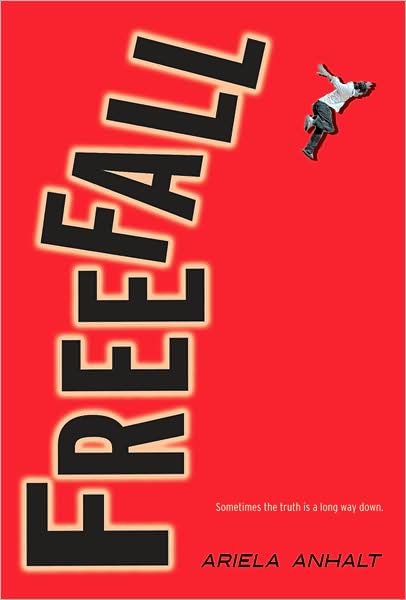
Freefall by Ariela Anhalt
4Q 3P; Audience: S

Three boys went up to the cliff. Two came down alive. One didn't. Did Russell fall or was he pushed? If he was pushed, was it on purpose or not? Luke is the only known eyewitness, and everyone wants him to tell what he saw that night. Hayden is his best friend and roommate, but if Luke is being honest, he knows that Hayden pushed Russell that night. But he's not sure what Hayden's intentions were when he did it. Trying to figure out what happened and why is tearing Luke up, and he can't bring himself to talk about it.

This isn't a book you pick up when you want a nice, cozy read. Luke's a mess. Not only is he dealing with the events up on the cliff, he's dealing with his father's suicide and its aftermath. He's angry, he's lonely, he's confused, he's guilty, and he's in a lot of pain. Like Cass and Tim in Give Up the Ghost, he needs help and refuses to ask for it. My heart ached for him, but I also got annoyed, because people do try to help him, and he rejects them every time. That's consistent with his personality and his issues, but it sure was frustrating! I felt the strengths in this book were the build-up of tension (internal and external) in a very narrowly focused storyline, Luke's very realistic struggles with deciding not only what he saw but what is the right thing to do about it, and the characters' interactions. Anhalt is still a college student herself (at Dartmouth), and she's right on the money with the way teens and young adults speak to each other. (People who object to cursing in general or in books should keep that in mind.) This book may not fly off the shelves, but a good booktalk should sell it to readers who enjoy introspective reads and character development over plot.


Crazy Beautiful by Lauren Baratz-Logstead
3Q 3P; Audience: J/S


Lucius blew off his arms in an explosives experiment that went horribly wrong. Instead of replacing them with realistic prosthetics, he's opted for hooks, a pretty clear indication that he intends to keep people at a distance. A very intelligent loner even before his accident, Lucius has come to accept his outcast status. That changes when Aurora steps onto his bus. Not only is Aurora beautiful, but she also is somehow both willing and able to look past his disfigurement to see the person he truly is. That's actually a somewhat frightening prospect, because Lucius has secrets he's not proud of, and the thought that learning the truth about his accident and the kind of guy he used to be might make Aurora shun him scares him. But Aurora knows more about pain and loss than Lucius suspects, and a tentative friendship begins. It's a friendship that doesn't go down well with the popular kids, especially Jessup, who has his eye on Aurora too. Jessup sets in motion a plot to make Lucius pay for attracting Aurora's attention, and soon Lucius finds himself even more of an outcast than he was before. Even Aurora has turned against him. Now what?

This story has some beautiful moments, especially in scenes between Lucius and Aurora. Told in first person by both characters, we frequently see the same scene from both points of view, which can be illuminating. Lucius has enough warts to make him intriguing. He doesn't spill all his secrets right away, so we don't know what happened to him or why. He's clearly intelligent, and he clearly has always felt superior to most of the people around him. He's also guilty about what he did (whatever it was) and how it's affected his family. You get the sense that he's not who he used to be and that he's realized he'd like to be a bit more a part of things, but he doesn't quite know how to go about this business of being friendly, let alone being a friend. For the most part, I thought Baratz-Logsted handled his attempts to grow quite deftly. Aurora is a far more idealized character. She's handling the death of her mother with grace. Immediately accepted into the in crowd at her new school, she is aware enough to realize that she may not want to be a part of it and that Lucius is a more authentic, interesting person to be with. It is impossible not to feel drawn to her. She's the epitome of nice, sweet, and friend. So once Jessup's plot started rolling, I was surprised she didn't see through it and nip it in the bud. This is when the book started to strike some significantly discordant notes for me. I flat out didn't believe the ending. Without saying too much, questions weren't asked by characters who would have asked them, and Lucius becomes some sort of magician in his ability to make people listen to him when they never have before, in situations where they were not at all likely to be willing to listen. I understand that this is supposed to be a retelling of Beauty and the Beast, but this fairy tale ending didn't match the rest of the story.

Some of the writing is beautiful and evocative. I'm not going to quote widely here, but here are two sections that I marked:


I feel as though my whole body could explode at her touch. Nobody ever touches me if it can be avoided. And, for the most part, I have been content to keep the world at this distance; at arm's length, if you will. But not now. This is the first time that anyone outside my family has touched me in a very long time, and my entire body feels it, enjoys it, fears it. (p. 119)

This is, I think, what it must mean to be human: to want something good for someone else. (p. 126)


Thursday, March 18, 2010

Quick Hits: Part I

I'm seven books behind in posting, not including posts already in draft. A bunch of new books just came in, which is going to get me even further behind. So I'm just going to do a some quick impressions of a few of the books I've recently finished.

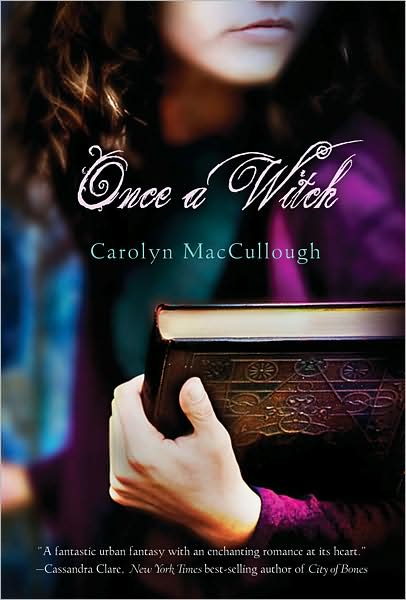
Once a Witch by Carolyn MacCullough
3Q 4P; Audience: J/S


Tamsin is the only unTalented person in her family, even though her grandmother predicted when she was born that she would be immensely powerful and a beacon for all. She's felt like an outsider her entire life, which partly explains why she agrees to take on a "finding" task even though she's not the person the request is intended for. As she works to find the item, a lot of things change: she discovers she truly is very Talented indeed, she gets reacquainted with her best friend and sparks fly, and she puts her family into the gravest danger they have faced in over a hundred years.

Magic, romance, time travel, and danger: it's a great mix. Tamsin is a very relatable character. I felt very positively about this book right up until the climax, where it fell apart a bit. It wasn't clear to me what the villain actually needed to do in order to achieve his objective, but somehow our protagonist (Tamsin) knew exactly what he planned. Predictions about the future are an important element in this book. It's made clear that "the future is like water", so a foreseen future can still change. But we should at least see the branching point where things could go one way or the other. There's at least one prediction about what will happen if Tamsin Travels into the past that has her mother in a panic, yet I don't recall any situation where Tamsin actually finds herself confronting that likelihood or any slight change that prevents it from occurring. It would appear from the ending that there will be a sequel, so perhaps that prognosticated event has yet to happen. But if that's the case, why is it so prominently mentioned now? I also thought Tamsin adapted to her new-found Talent and power awfully quickly. But overall, I liked the characters (though some of the family members and their Talents push the edge of twee), especially Tamsin and Gabriel, and I was caught up in the story most of the way through. It was a good escape-reading book.

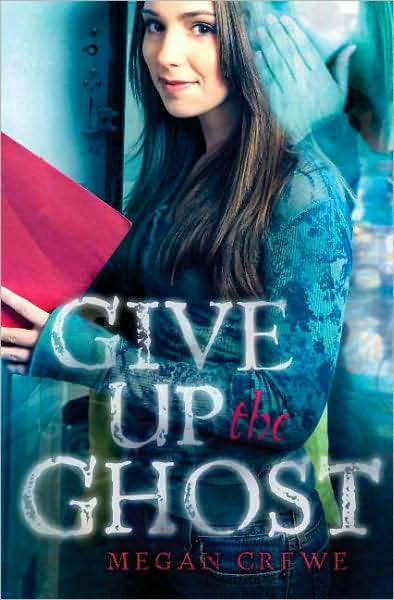
Give Up the Ghost by Megan Crewe
4P 4P; Audience: J/S


Ever since her sister Paige died, Cass can see and talk to ghosts. For years, she's used this ability to gather dirt on her classmates, particularly the ones who have been giving her grief ever since middle school. Very much the loner, she doesn't know how to react when Paul, one of the guys who hangs with that group, asks her for help contacting his dead mother. She makes a deal with him: she'll help him if he'll help her get the goods on her ex-best friend's boyfriend. What she doesn't count on is how very messed up Paul is. What she doesn't expect to do is let someone see the real her for the first time in a very long time. After years of allowing only ghosts into her life, interacting with a live human being is difficult and frightening.

Ghosts aside, this is a keeping-it-real novel. Cass is dealing with the loss of her sister, a mother who seems to want to be anywhere but with her, and a betrayal by her best friend that has left her a social outcast. She's unhappy, angry, and unable to trust anyone. Paul is in a world of hurt. He's as angry at his friends as Cass is. None of them seem to understand or care how he feels about his mother's death, and he feels totally alone. These are two people who need to reach out to someone else and who are equally unwilling or unable to do so. Certainly they have no intention of revealing their pain to each other, and it's a surprise to both when it happens.

Minor quibble: Middle school can certainly be a miserable experience, but people generally move on from its petty backstabbing and casual cruelties a little better than Cass and her one-time friends do. I found it a little hard to believe that she was still persona non grata four years later. Danielle's dirty work and Paige's death (and Cass's new-found ability to see and talk to ghosts) came almost simultaneously, so we're asked to accept that the two together set Cass on her leave-me-the-hell-alone path. Mmmm...okay, I'll go with it, but with a raised eyebrow.

There's no presto-chango magic fix in this book. Change is slow and painful, and there's not much of a tidy wrapping up at the end. I was left with a sense of life going on as a work in progress. Grieving and forgiving and learning to trust are all things that take a while, and this book acknowledges that. I appreciated that.

Thursday, March 11, 2010

Happy About After Ever After

After Ever After by Jordan Sonnenblick
4Q 4P; Audience: M/J

I laughed and cried my way through Drums, Girls, and Dangerous Pie, and I was eager to enter that world again. I was not disappointed. When we last saw Jeffrey, he was a five-year-old fresh out of the hospital tackling his brother with a great big hug. It seemed as though he was out of the woods, and readers were left with a picture of a happy family celebrating his brother Steven's graduation from eighth grade. But what happened after that? Now we know. After Ever After jumps to Jeffrey's own eighth grade year, when his graduation prospects are a little more tenuous than his brother's. After included two more years of leukemia. After included chemotherapy. After included learning to cope with the after-effects of that chemotherapy: he's slower to process things than he used to be, he has trouble paying attention, mathematical concepts slip from his brain as quickly as a monkey eats a banana, and his drop foot keeps tripping him up.

Now Jeff is crushing on the new girl (Lindsey) and wondering if she's crushing
on him too. Now Jeff is trying to keep his best friend and fellow cancer survivor (Tad) from imploding, exploding, or causing all kinds of mayhem with his take-no-prisoners attitude. Now Jeff is enduring hours of tutoring each week in the hopes it will help him pass the state math test, because if he doesn't pass, he won't graduate. Now Jeff is missing his lifeline Steven, who is off playing drums in Africa. And just like then, nothing is going to keep Jeff down for long.

Musings:

Now Jeff is every bit as captivating and indomitable as he was eight years ago, and it's a pure pleasure to catch up with him again. Just as he did in Drums, Girls, and Dangerous Pie, Sonnenblick shows a deft touch in blending the lines between humor and and tears. Jeff is a real kid. At times he's a little more mature than most boys his age, and given what he's been through, that's hardly surprising. But he's also an awkward, insecure, slightly goofy thirteen-year-old who sometimes puts his foot in his mouth and makes bad decisions. He's utterly charming, and I can't think of many readers who won't enjoy getting to know or get reacquainted with him.

A few of the things I really liked:


  • Jeffrey's determination and courage, which brings me to:
  • the training scenes in the gym (Jeff would make a great personal trainer)
  • Jeff learning what this girl thing is all about
  • Jeff's friendship with Tad, with all its bickering and truth-telling and deep understanding
  • that to balance Jeff's glass half-full character, Tad is dark and prickly and not always likeable
  • lines like "Lindsey has a sprig of mistletoe over her bedroom door. Just sayin'."
  • Jeffrey's journal articles and (unsent) emails to Steven: he writes as affectingly as Steven did
  • Jeff. You just can't help liking this kid.


I was under the impression that the effects of cancer treatment on young children is fairly recent research, so I was a little surprised to discover just how much this book focuses on that. I gather that Jordan Sonnenblick had both a student who really influenced him in the writing of this book and Drums and some nurses who encouraged him to write about the issue. It's certainly something new in YA literature, and I'm sure it's welcome to the patients and families who want people to know that the cancer story isn't necessarily over after a patient goes into remission.

I'm looking forward to introducing both Steven and Jeff to my younger teens and sharing their stories with them.

(For my take on Sonnenblick's Notes from a Midnight Driver, see this post.)


Tuesday, March 09, 2010

A Joy Ride + a Fair Day = Something Much More

The Miles Between by Mary E. Pearson
4Q 3P; Audience: J/S)


October 19th has always had a special significance for Destiny Faraday. It's her birthday. It's her mother's birthday, too. It's the day she first got sent away to boarding school (that was ten long years ago). It's the day that her aunt always comes to visit her. Since her family has virtually ignored her for all of those ten years, the visits from her aunt are highly anticipated events. Or at least, they're as anticipated as Destiny will allow herself to be, since she's practiced for years not to let herself expect or hope for anything. But this year, her aunt can't come, and Destiny lets herself get angry enough to wish, just for once, for one fair day, a day where everything happens the way it should happen. When a pink convertible with keys in the ignition (and money in the glove compartment) appears on the school lawn, it seems as though it's practically inviting her to jump in. The problem is, she can't drive. But she knows somebody who can, and he's already in trouble. So...

And thus begins an unplanned and unauthorized car trip. Just Destiny and three of her classmates: the new boy who intrigues her, the always-rational boy who exasperates her, and the too-cheery dormmate who is always friendly despite Destiny's attempts to push her away. They, too, feel a need for one fair day. What they get is a day full of surprises, some small and some shocking. At the end of the day, what Destiny gets is more than she dared let herself hope for. From now on, October 19th will be the day her life started again.


Musings:
This was a quick read, but I think that's a little deceptive. This is probably a book that would be worth going back to read a second time, just to notice the small details and nuances that were easy to miss the first time through. Like Christopher Wooding, there have been times when I just haven't gotten Mary Pearson (David v. God and Scribbler of Dreams). But The Adoration of Jenna Fox deserved most of the acclaim it got, and I absolutely loved (and cried over) A Room on Lorelei Street. I'm becoming a convert.

Who can't relate to wanting a day that everything goes right, especially when so much is actually going wrong? The book has a good hook right there. I liked the feel of this book. I really enjoyed some of the quiet moments, particularly those when Destiny and Seth were beginning to connect. The lamb (oops, my bad: the lambadoodle) purely and simply made me smile. And I thought the gradual bonding, coupled as it was with Destiny's gradual realization (mostly through watching Aiden and Mira interact) that her perceptions of the way things are may need to be adjusted, was well done. Those lighter moments were nicely interwoven with darker tones. It's clear that there's something disturbing going on in Destiny's life. What, after all, could a seven-year-old girl have done to make her parents send her away and refuse to let her come home for all these years? Why is she so overwhelmingly guilty and so desperately determined not to let herself get close to anyone? To be honest, I was ahead of the game figuring out at least some of that. But seeing how it all played out was still quite satisfying and cathartic. I appreciated how everything that went into this one fair day, whether it was something as big as meeting the President or as small as a touch of a hand, helped bring Destiny to the point where she could begin to accept the truth and move on in a healthier direction.

While I'm going to tag this as realistic fiction, that's not strictly accurate. There's just enough of a hint of the supernatural, or something akin to it, to intrigue. At the very least, destiny is at work in this story of the carefully-named Destiny Faraday.

On Keeping One's Distance, Purposely and Not

I'm really far behind in posting on books I read in January and February, so I'm going to try to toss up a few slightly shorter posts. (Of course, with me, slightly shorter generally means five or six paragraphs instead of seven or eight! So shorter is definitely a relative term!)

How to Say Goodbye in Robot by Natalie Standiford (4Q 3P) has already gotten all kinds of attention in blogs and review journals. It seems to be one of the hot books of the season so far. While I enjoyed reading it, I don't think it's going to be on my top ten of 2010 (technically, it's from late 2009, but I read it in January).

Bea is accustomed to moving, but this time, things are different. Nobody wants to start a new school in their senior year. And her mother is acting very strangely. She's crying at the drop of a hat and fixating on chickens. When Bea refuses to cry when a gerbil that isn't even theirs dies, her mother calls her a robot for being so heartless. Bea decides being robot-like isn't such a bad idea. Things hurt less when you don't feel anything. so she decides not to feel anything. She meets Jonah at school, where she's purposely keeping her distance from everyone. Jonah's been called Ghost Boy for years, both because of his albino-like appearance and because he keeps such a low profile that he's practically invisible. For some reason, Jonah will talk to Bea, and he's the one person she lets into her life in any meaningful way. Jonah finally reveals the tragedy that's been the driving force in his life: the death of his mother and twin brother in a car accident. When Jonah discovers that his father has been lying to him about the accident and its aftermath for years, he and Bea go on a seemingly hopeless quest to find the one thing that can fill the hole in his life.

Musings:

Bea and Jonah keep people at arm's length, and that's pretty much how I felt about them too. I didn't connect to them at the level I wanted to, even though Jonah's situation was infuriating and very sad. Bea's story might have been more compelling for me if it had continued to develop in the direction it seemed to be going. But ultimately, the issues surrounding her mother didn't hold together for me. I couldn't buy the reactions that resulted from the cause. I did like the use of the late-night radio show and its quirky loyal followers to give them a place they could fit in and be accepted. Those sections were a welcome relief from the cold, like cuddling up with an afghan and cocoa after being outside on a dreary February day.

Food for thought: Are Bea and Jonah good for each other? Is Jonah what Bea needed at the time, or did their friendship reinforce her robot responses to everyone else around her? Would it have been healthier for Jonah if Bea had encouraged him to handle his discovery of his brother and his father's decision differently? Are Jonah's actions at the end selfish or self-preservation?

Tuesday, March 02, 2010

With MALICE Aforethought

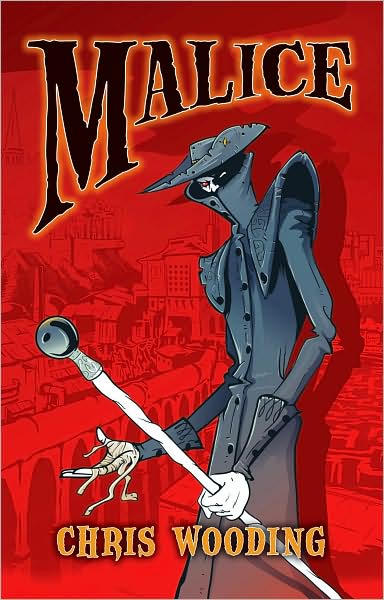
MALICE by Chris Wooding
4Q, 3P; J/S

Kids are going missing. Sometimes they show up again weeks or months later, but they can't remember where they were or what they did. The police and their parents are baffled. If they knew about the existence of Malice, their questions might be answered. What is Malice? It's a really creepy comic book set in a place called Malice. In its pages, kids fight for survival against strange, terrible creatures. But it's not just a story. Malice is a real place, and everything in Malice is real. You won't find Malice in most comic book shops, and most shopkeepers will claim they have no idea it even exists. But if you're really determined, you can get your hands on a copy. You might even be tempted to go to Malice, to have a few adventures yourself. You might be tempted to gather the materials and perform the ritual that will get you there: "Tall Jake, take me away! Tall Jake, take me away!".... But you'd almost certainly regret it.

Luke is one of the kids who disappeared. Only three people know that Luke had a copy of Malice. Only they know that he did the ritual. Only they know that Tall Jake did take Luke away to Malice. Only they know that Luke isn't coming back. How do they know? Because they saw him die in the pages of the comic book.

But is it really true? Is Luke really dead? Seth is determined to find out. He knows it's dangerous, but he's always hated the dull, predictable life his parents lead, and he's always been afraid he'll wind up just like them. He's always liked to push the edge and get the thrill that comes when you're really up against it. What better place to do that than a place like Malice, where there's no room for error and your life is always on the line? Seth too does the ritual ("Tall Jake, take me away...") and becomes one of the missing kids. Within minutes of his arrival, he has narrowly escaped his own death and witnessed another's at the hands of one of the vicious mechanical inhabitants of Malice. It only gets worse from there.

Left behind by Seth, Kady sets off on her own quest to get to the truth. Her search leads her into just as much danger as anything she'd find in Malice. Because what Kady finds are the people deeply, evilly connected to Malice. And they know who she is and where she lives.

Their search for answers leave Seth and Kady staring death in the face and the readers of Malice on the edge of their seats.

Musings:

The decision to tell this story partly in prose format and partly in graphic novel format was brilliant. Each time the story moves to events in Malice, the book shifts into graphic novel mode. In effect, the reader takes on the role of one of the readers of Malice (the comic book) who is watching the events unfold before his eyes. It takes the reading experience to a different level.

In the past, I've had a hard time getting into Chris Wooding's books. I don't think that had a thing to do with the author. The books just weren't right for me. I found this story to be a more comfortable fit, though a book this dark is certainly far from a comfortable read. I was intrigued by the premise.
I thought Wooding did a particularly good job creating the aura of Malice. Its bleakness and hopelessness is emphatically punctuated by bursts of terror and rushes of adrenaline. I'd never want to go there, but I can understand its appeal to someone like Seth or Justin.

I am not skilled at reading graphic novels, which meant that I occasionally had some trouble interpreting what was happening in the illustrated portions. That was somewhat frustrating for me, but I think the majority of the target audience is more familiar with the format and will have less trouble.

As well-developed as parts of the novel are, I do have some quibbles with it. The role of the various villains and how they are connected to each other is very murky. There doesn't appear to be any particular reason for their actions, and even a bad guy ought to be given some motivation for doing the things he does.
As Tall Jake makes clear on the last page of the book, he will be back in a sequel soon, so I expect the holes will be filled in a bit then. But while it's true that when a book is intended to be a part of a series there have to be things you still want to know at the end of the first book, it 's also true that the book should still be complete unto itself. I think Malice falls a bit short in that department.

I will recommend this book to readers who like dark, atmospheric books, graphic novels, and suspense, and readers who don't mind unanswered questions.


Tuesday, February 23, 2010

Thrills and Chills, Steampunk Version

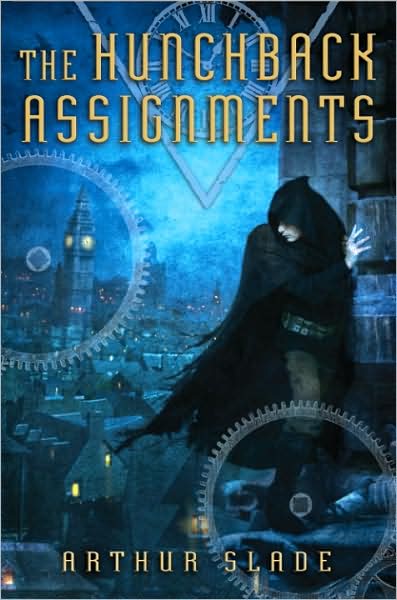
The Hunchback Assignments by Arthur Slade
4Q, 3P; Audience: M/J

Modo started his life on display as a freak in a side show. Was he rescued by Mr. Socrates, or was he merely taken from one bad situation and thrown into a new one almost as bad? What kind of savior would keep him locked up in two rooms of a house for years with only a housekeeper and a fight trainer for companions? What kind of savior would take him out of that situation, only to abandon him on the streets to see if he can fend for himself at the ripe old age of fourteen? Mr. Socrates, it turns out, has big plans for Modo, assuming he can pass this heartless test.

For some readers, it will come as no surprise to learn that Modo, born in the shadow of Notre Dame cathedral, has a humped back and a misshapen face. But Modo is not destined to become a bell ringer. Modo has the extraordinary ability to move the bones and muscles of his face and body into new configurations for a short time, to transfigure himself into the likeness of someone else. With that skill as well as the education and training he received in his years of isolation in Mr. Socrates's mansion, what will happen when a mysterious young woman hires him to learn more about her brother's association with the mysterious Young Londoners Exploratory Society?

What happens is far more than Modo or Octavia (the young woman) bargained for, leaving them fighting for their lives and the survival of their country against enemies that are both truly mad and absolutely ruthless. To make matters worse, it's not at all certain that Mr. Socrates and the organization he represents are any better.

Musings:

Like Leviathan, this belongs to the growing list of YA steampunkNonstop action, moments of violence, tinges of gore, and horrifying hybrid human-machines (courtesy of a familiar mad Dr. Hyde) give this book sure appeal to boys who are willing to look past a cover that screams historical fiction. The villains are creepy and chilling (the image of a metal finger poking Modo's eyeball is hard to get rid of), and the aura of menace surrounding them is nearly tangible. Modo and Octavia are likable, resourceful characters, and the occasional bantering between them offers a welcome lightening of the mood. Where the book faltered a bit for me was in the revelation of the actual intentions of the villains. It felt a bit like an afterthought and the execution seemed a little rushed. But by that time, I was so invested in the characters and setting that the relatively weak payoff didn't get in the way of my enjoyment. Nothing in this book actually promises a sequel, but there are definitely strong hints that this is intended as a series. If that's true, I would happily read the next.

The website for the book looks like fun to poke around in. I enjoyed the Victorian factoids on the Steamtrunk page. Interesting difference between the Canadian/Australian and US covers. I think the US cover is more atmospheric, but the Canadian/Australian cover is probably more appealing to kids and teens.

Thursday, February 18, 2010

The Faster I Read, the Behinder I Get

I have three half-finished posts to complete and publish and seven more books I've finished and haven't even started to write about after that. Yikes!

In the offing:
  • Food, Girls, and Other Things I Can't Have by Allen Zadoff
  • Purple Heart by Patricia McCormick
  • Giving Up the V by Serena Robar
  • Jumping Off Swings by Jo Knowles
  • How To Say Goodbye in Robot by Natalie Standiford
  • Hate List by Jennifer Brown
  • The Hunchback Assignments by Art Slade
  • The Miles Between by Mary Pearson
  • Day of the Assassins by Johnny O'Brien
  • Malice by Chris Wooding
I'll try to get something post about each of these as soon as possible. If I were less long-winded, it would be easier, but those of you who read me regularly (or as regularly as I post, anyhow) may have noticed that brevity is not my strong point!

Tuesday, February 09, 2010

Handling the Truth

PURPLE HEART by Patricia McCormick
4Q 3P; Audience: J/S

When Matt wakes up in the hospital, he's got a heck of a headache, a lot of pain, and a Purple Heart for wounds sustained in combat. How did he get there? All he remembers is being on checkpoint duty with Justin, a chase after a taxi that burst through their barricade, an alley, and a dog with a broken tail. But what happened then? How did he wind up in the hospital? His doctors tell him he has a traumatic brain injury that will make him dizzy, anxious, and moody. It will keep him groping for words and groping for memories. They're right. The more Matt tries to remember what happened, the more frustrated and upset he gets. Something else happened in that alley, and it was something bad. Something about a little boy and the dog. Why can't he remember what it was? And why does it seem as though nobody really wants him to remember?

Musings:
Most of the books I've read about soldiers have been focused primarily on what happens in the field. They rely on battle scenes for their action and tension. In this book, the tension derives from Matt's confusion over what really happened in that alley and his gradual realization that the official story and the real story may have significant differences.

I hated to see Matt so lost and so unable to find comfort in the places he used to be able to find it: his high school sweetheart, his faith, and his platoon buddies. I hated that he wasn't given time to heal completely before he was sent back to his unit (apparently a very common circumstance). I hated that Matt's faith in people gets sorely tested. As I turned the last page of the book, I could only hope that Matt is able to heal both emotionally and physically sometime in the not-to-distant future.

Without being too spoilery, I know the key element to the events as McCormack describes them has happened and probably will continue to happen, and the motivation that she/Matt provides for it appears plausible. But it still disheartened me, and true-too-life or not, I wish she had chosen a different path. And I suspect that's exactly the reaction she hoped for when she wrote it.

This book might not have all the high-stakes action boys usually want when they ask for a book about war, but I think most of them will not be disappointed when they pick this one up.

For more on this book: http://www.harpercollins.com/authors/33041/Patricia_McCormick/index.aspx


(Yikes! I started this post on February 9 and I'm just posting it now!)


Wednesday, February 03, 2010

To Be or Not To Be...a Virgin

It was a coincidence that I picked up two books back to back about teens losing their virginity, but it makes sense to talk about them together. The main characters in the two books have made very different decisions about sex, for very different reasons, and both are forced to confront those decisions when a seemingly casual encounter with a boy pulls them up short. But as interesting as their stories were, I found myself paying at least as much attention to the secondary character in each book who decides to lose his/her virginity as a result of societal pressures. More on that below. I found both books to be good reads and worth thinking and talking about, but it is the Knowles book that will stick with me longer and which I think will resonate most with its readers.

JUMPING OFF SWINGS by Jo Knowles
5Q 4P; Audience: S


All Ellie wants is to be loved. She wants that feeling you get when someone holds you close, kisses you, cares for you. Each time she sleeps with a boy, she thinks that's what she's going to get. But instead of feeling loved, she just feels empty and just hates herself a little more. The night she hooks up with Josh, they both have high hopes. He's tired of the guys in the locker room teasing him about being a virgin. They tell him Ellie will take care of his problem ("She's really into it!"). After a few minutes with Ellie, he's no longer a virgin. But one glimpse of the look on Ellie's face as he walks away leaves Josh feeling ashamed, not relieved or ecstatic. As for Ellie, she hopes this time it will be different, that Josh will be different. But he's not. She still feels just as empty, just as unloved. The only thing that's different is that this time Ellie gets pregnant.

Told by Ellie, Josh, and their best friends Caleb and Corinne, this is a poignant, makes-your-heart-hurt story. Nobody is a villain here. Ellie's need for love leads her to keep making poor choices. Josh is embarrassed and ashamed when he realizes too late that Ellie wanted and needed something from him that he was not prepared to give. He's shocked and confused when he learns she's pregnant and totally at a loss about how to handle the situation. Corinne tells her side of the story as a loyal friend who is sometimes frustrated by Ellie but who will always stand by her. Caleb's story is the pain of having to watch someone he loves hurt so much, unable to tell her how he feels.
There were so many things to like and admire about this book. The three-dimensional characters and their actions and reactions ring true, Ellie and Josh in particular. I really appreciated that Josh was portrayed as someone in as much pain and confusion as Ellie, rather than as callous or callow. I loved Caleb's mother, both as a character and for being there for Ellie when her own parents aren't. I loved the warmth of those scenes contrasted with the emptiness of so many of the others. And I loved that there are no easy choices here and that Knowles didn't tie everything up in a perfect little bow at the end. There's so much more to say about this book, although I've already said too much.

GIVING UP THE V by Serena Robar

3Q 4P: Audience: S


Spencer Davis's mother's idea of a perfect 16th birthday present for her daughters is a trip to the gynecologist for their first exam and a prescription for birth control pills. It is not Spencer's ideal gift. She's mortified, though her friends (guys and girls) all think it's terrific. They all expect Spencer to take full advantage of the situation. But Spencer has no interest in losing her virginity right now. For one thing, other things are a lot more important to her. For another, there's nobody she's even remotely got her eye on, and she wants her first time to be with someone who is special, so that it means something to both of them. In contrast, her best friend Alyssa just wants to get it over with. She's even made a list of guys she's willing to give it up to. Complications arise when Benjamin enrolls in their school. Suddenly Spencer isn't so sure that she has no time for boys and serious dating (and perhaps more). She's thrilled every time he talks to her, and her body tingles every time he touches her. Now she gets what this whole sex thing is all about, and having those birth control pills in hand is looking like a very sensible present after all. The trouble is, Alyssa just moved Benjamin to the top of her lose-it-to-him list, and she's doing everything in her power to make sure Ben knows it. Should Spencer pretend not to like the boy she can't stop thinking about so her best friend can have him? (Or, rather, he can have her.) Or should she go after him herself to see if she's ready to give up the v after all?

This book is a fairly intelligent look at teens who are trying to decide what is right for them in terms of their sexuality. It's fair to say that while I recognize that Alyssa is representative of many young girls, I had a hard time sympathizing with her goal.
I think it's a shame that there's so much emphasis on sex in our culture that some teenagers "give up the V" because they don't want to deal with the pressure. What I appreciated about Spencer was that she wouldn't allow herself to be coerced into something she wasn't ready for just because her friends and/or society were telling her she should be. It's not surprising that I, as an adult, feel that way. I wonder which of the two girls most readers will empathize with.

These two are on either end of the spectrum. Also represented are Spencer's friends, most of whom are happily and vociferously sexually active, either as part of a (frequently battling) couple or playing the field.
Though the energy level in the book goes up a notch or two whenever they are on the page, they're stock characters and a bit overdrawn. I found myself wondering on more than one occasion how Spencer fit in with this group. I had the feeling that this was a group that may have been close friends at one time, but would more likely have grown apart over the years. It has only just occurred to me that they're in the book primarily to represent that full spectrum. They are also quite raunchy and randy, making for one more reason this book is recommended for older teens.

I found the ending to be predictable, but I think readers will appreciate it, regardless.

Tuesday, January 05, 2010

Best YA Books of 2010? You Pick!

In association with the Children's Book Council, TeenReads.com wants to know what your five favorite books published in 2009 were. The top five most nominated books will become the finalists for the Children's Book Council's 2010 Teen Choice Book of the Year. Why not go vote for your favorites? (It doesn't say whether the voters must be of a certain age, so I'm not sure whether the voting is open to everyone or just to teens. But the form doesn't ask how old you are, so...?)

By the way, TeenReads.com is a terrific resource. I find their reviews very helpful and as a fan of their Facebook page, I get weekly alerts about new books. If you aren't familiar with the site, do check it out.

By the way, once the finalists list is published, I'll try to post a similar link to that vote.

Wednesday, December 23, 2009

Leviathan: A Whale of a Story

LEVIATHAN by Scott Westerfeld
4Q 3P; Audience: M/J/S

This is another book I finished quite a while ago but haven’t had the time to write about. (It’s a good thing I don’t write under deadline. Then again, if I did have a deadline, maybe it would help get my thoughts marshaled into order and out of my head in a timelier fashion!)

It’s 1914. Europe is divided between two ideologies, Clanker vs Darwinist. The Clanker countries rely on mechanical technology – iron and steam-powered devices such as the enormous multi-legged machines that carry them into battle. The Darwinists bioengineer animals to create not only beasts of burden but also weapons of war. A face-down is fast approaching.

When Aleksander Ferdinand, prince of Austria-Hungary, is woken in the middle of the night by two of his tutors, he has no idea that he has just become a pawn in the political maneuverings of the Clankers. He has no idea that the assassination of the Archduke has left him an orphan or that his continued existence may be the spark that provokes a world war. All he knows is that he and a small band of loyal men are on the run, and the only thing that may keep them alive until they reach their safe house is the protection of their Cyklop Stormwalker and its cannon and machine guns.

Across the ocean in London, Deryn Sharp is preparing for the midshipman’s entrance exam into the Royal Air Service. She’s confident of passing every test but one: will she be able to convincingly play the part of a boy so that she’s allowed to follow her dream?

When a furious storm during her testing leaves Deryn/Dylan and her Huxley ascender floating miles off course, she is rescued by the Royal Navy’s largest air ship, the Leviathan (a sperm whale enhanced by a hundred other species). But instead of returning her to London to continue her test, the crew, Deryn/Dylan included, has been ordered to fly to the Continent to keep an eye on the Clankers in the wake of the Archduke’s assassination.

Both Alek and Deryn are catapulted into the middle of world-changing events. On opposite sides of the edge of war, what will happen when their paths converge?

Musings:

I’m just discovering steampunk (see also: Wikipedia's article) and finding that I like the combination of science fiction and alternate history to explore how the addition of technology (either anachronistic or fictional) might have affected the (usually*) Victorian Age. It helps that the mid-late 1800’s is my preferred historical fiction time period. (*Edited to add that I'm aware that this book is set a few years post-Victorian Age.)

What I really liked about Leviathan:
  • The fast pace. It’s pretty much non-stop chases, clashes, and collisions.
  • Devyn’s part of the story is at least as action-packed as Alek’s, so the girl never takes a back seat to the boy.
  • Alek, Devyn, and Count Volger are forceful personalities that really burst off the page. In particular, I love Devyn’s feisty, take-no-guff attitude.
  • Alek’s evolution (it’s formulaic, to be sure, but effective nonetheless)
  • Westerfeld doesn’t get too bogged down describing the new technology, be it Darwinian or Clanker (Though I got confused in a few places, it didn’t really matter.)
  • Striking black and white illustrations which really set the mood and style of the story.
  • C’mon! Who wouldn’t have fun with the idea hitching a ride on a giant jellyfish or gargantuan sperm whale?

  • It's a trilogy, so there's more to come!

What I didn’t like as much:
  • Nothing, really. But I guess I’m a Darwinist at heart, because I was more intrigued by the idea of the bioengineered animals than I was with the machinery of the Clankers. I was a more interested reader when the action began centering around the Leviathan.
  • We have to wait until late 2010 for Book Two (Behemoth).

To hear a chapter from the book, see some of the illustrations, or just read Scott's thoughts about the series, check out Scott Westerfeld's blog. Scott also blogged about how he structures his books to make sure there's a good blend of action, tension, and "nothing".

This book will appeal to both boys and girls who like adventure and action. It’s a natural suggestion for readers who enjoyed Kenneth Oppel’s Airborn series, the Bloody Jack books by L.M. Meyers, or Philip Reeves’s Mortal Engines* and/or Larklight* series. (*These two series are miles apart in tone, but both have elements which pair well with Leviathan.)

Monday, December 21, 2009

After the Headlines, There's More to the Story

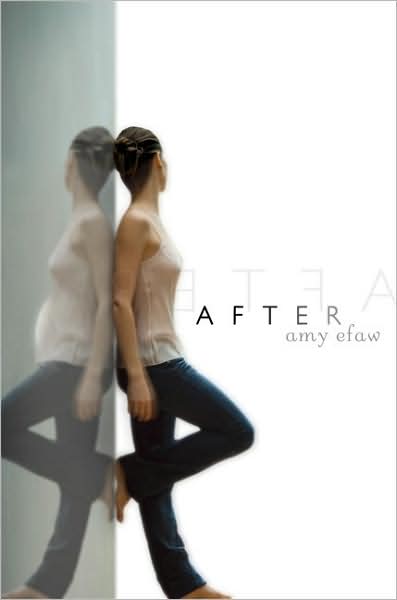
AFTER by Amy Efaw
4Q 3P; Audience: J/S (High School)

Devon Davenport did not have sex. She did not get pregnant. She did not give birth. She did not wrap the baby in a towel, then place it in a garbage bag and put it in a dumpster. She couldn’t have. But that’s exactly what the police, the doctors, and her lawyer say she did, and they have the evidence to prove it.

Locked in a juvenile detention center, charged with attempted murder and possibly to be tried as an adult rather than a juvenile, Devon has to explain to her lawyer what happened. But how can she put into words what she has spent the last nine months refusing to admit even to herself?

Musings:

I admire Gail Giles for her ability to write with great sensitivity about teens who have committed a terrible act. She doesn’t excuse what they do, but she makes us see the whole person and the whole story, reminding us not to look at events in a vacuum. By the end, we may still not be able to forgive, but we may at least be able to understand. With After, Amy Efaw proves herself a worthy companion to Giles in this regard.

I am not generally a fan of books written in the present tense, but it really worked for me in After. It made it impossible to keep Devon’s emotions and reactions at a distance. From the very first scene, Devon lying on the couch so numb and so in shock that she is barely aware of what is happening around her, I got into her head. I felt first her confusion, then her blind panic, fear, and humiliation as she began to comprehend her situation. At times I felt my own gut tightening in response to Devon’s tension, particularly as she began the painful process of not only facing the truth at last but of revealing it to someone else.

Clearly, what was very effective for me doesn’t strike everyone the same way. Though the majority of customer reviews on Amazon are positive, there are some negative comments as well. Several of them disliked the writing. Honestly? I think they missed the point. True, the prose does not always flow smoothly and lyrically. But why should it? The book is about a girl who can’t articulate what made her commit such a heinous crime. Lyrical, flowing language would be inappropriate for the story being told and the character experiencing it. I thought Efaw nailed it.

I wanted to slap Devon’s mother silly. Talk about abandoning your child!

How she views herself and how others view her is of the utmost importance to Devon. Her whole life has been centered around being a responsible, trustworthy, successful person. She can’t allow any cracks in that persona. She isn’t lying because she doesn’t want anyone to know what she did. She’s lying because she doesn’t want to know what she did. The thought that everyone else knows devastates her. One of the scenes that affected me most takes place in the courtroom when Devon discovers that she has not lost the respect of her coach and (especially) of a former employer. I can’t remember now if Devon cried, but I have to admit that I did.

Should we feel sympathy for a girl who did such a terrible thing? Some people will be upset by the very idea. But it’s important to make the distinction between feeling sympathy and excusing her actions. Sympathizing and understanding why she did it doesn’t absolve her of responsibility, and Efaw acknowledges that. I was impressed by the choice made in the end, and it proved to me that Devon really is the kind of person we heard about from people testifying on her behalf. I hate what Devon did, but I can’t hate the person who did it. Amy Efaw, mission accomplished. (And please don’t make us wait another nine years for book number three!)

This is a hard book to read, but well worth it. It's also another excellent choice for a book discussion group.

Thursday, December 17, 2009

So upset!

I just tried to edit one sentence in my post about After by Amy Efaw and the entire post, which I have been working on for a week and was just about ready to upload is GONE. I hit Undo one too many times, I guess, and the post blanked completely out. Then the autosave feature came on and saved the blank page. I have tried using undo and redo, but there's nothing there in either direction. I am one very unhappy librarian. And I can't do any more research now on how I might be able to retrieve it because I have a program starting in ten minutes. If anyone reading this knows whether it's possible to get this post back, please let me know how to do it. (I tried to go into my history, but I had Firefox not to save history, so that doesn't seem to be an option.)

Wednesday, December 09, 2009

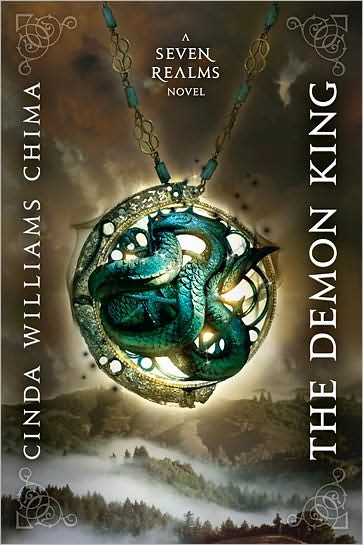
Where is the Demon King?

Musings

I thoroughly enjoyed Cinda Chima's Warrior Heir, Wizard Heir, and Dragon Heir. The plot and the characters were interesting and the pacing kept the story moving at a fast clip. I liked the twists and turns of the Warrior Heir and never being absolutely sure who could be trusted. I remember reading the beginning of Wizard Heir and gasping at the tragedy that occurs within the first couple of chapters. The series had me hooked from the beginning. I was sad to leave those characters behind.

It's not surprising, then, that I've been anticipating Chima's new series for months. When it finally arrived, it came at a time I had no time to read it. Twice my hold came in and I had to give it up and  put myself back at the bottom of the hold list, which was quite frustrating. Last week it came in again, and I decided to bypass another book in favor of reading this one at last. I intended to immerse myself in this new world, whatever it was, and expected to savor every minute. So it gives me a pang to have to say that this new series isn't grabbing me like the Heir series did.

  • It's 500 pages long. I'm on page 360 (note: I've now finished the book), and the action is only now kicking into gear. I enjoy reading long books, but that's an awfully leisurely set up.
  • Dancer's secret has finally been revealed. How many more pages before Cuffs learns his? (Answer: about another 80)
  • I still don't feel I know Amon and Dancer very well. Cuffs and Raisa are a little more fleshed out, but not as well as the Heir characters were by this point in their books. The only character I'm really invested in is Cuffs, and by this time, they should all be more important to me.
  • That being said, I still think Dancer is getting a rough deal, and I want to see how he works that out.
  • The timeline seems a little shaky. More than once, the implication has been that several days have gone by, but another character's scene  referencing the same events will indicate that only one or two have. Not a big issue, but it keeps tripping me up as I read.
  • At this point, the plot doesn't seem to be showing us anything new. A weak queen, wizards who have more influence than they should, political upheaval, and four (at least) teens with talents and abilities that will put them smack in the middle of the mix. I want something to surprise me. Is it coming?
  • Lots of foreshadowing makes me suspect that the pace is about to pick up dramatically, just in time for a great cliffhanger ending. 
  • Now that I've finished the book, I can't say we got a cliffhanger. But I do think the next book in the series will be much more action driven, now that all the pieces seem to finally be in place.
  • Yes, I'll definitely read the next book in this series. I may not be enthralled by this one, but I'm still a Chima fan.

Anyone want to yell at me and tell me I'm wrong, wrong, wrong? Anyone out there who agrees?

Tuesday, December 08, 2009

Books Speak to Her

LIBYRINTH by Pearl North
4Q 3P; Audience: J/S

Clearly, as a librarian, books speak to me. But they don't speak to me. They talk to Haly, though. For as long as she can remember, Haly has heard them muttering in her ears. She finds great comfort in this, but it's also a secret she doesn't dare share with anyone but her friend Clauda, who works in the kitchens. She doesn't dare imagine what would happen if the librarians and other clerks in the Library found out.

Once a year, the Eradicants arrive at the Library for their annual book burning pilgrimage. It's painful for all the Library's inhabitants, but for Haly, it's excruciating. Only she can hear the words, her friends and comfort, fall silent as they die in the flames. She hates the Eradicants for what they do to the Library and to the books. How can they believe that written words are dead and that burning them sets them free?

This year the tension surrounding the Eradicants' arrival is higher than it's ever been. The political situation is volatile and it's not only the Library that is in danger. Neighboring countries that have always protected it are also being threatened. As a result, when Selene, the librarian Haly clerks for, finds a map that reveals the location of one of the most coveted books ever written, someone she thinks she can trust betrays her. The information winds up in the hands of the Eradicants, setting up a desperate flight and search for the treasure that lands Haly in the hands of the Eradicants and Selene and Clauda seeking help from a monarch whose loyalties and priorities are always in question.

Already familiar with the pain the Eradicants can mete out, Haly is terrified when the Eradicants discover her secret ability. What else will they do to her? A realm away, Clauda is not only suffering from her own run-in with the Eradicants, her every move is suspect. Their lives held in the balance by political machinations and religious revelations, the girls are torn by their desire to save each other and their need to save the Library. It doesn't seem possible to do both.

Musings:

I wish books would talk to me. But it must be headache-inducing to hear them all at once!

I had a great time trying to identify the various quotes in the book. (I thought I'd have search for them online until I thought to turn to the end of the book and found them listed there.) I would love to hear North explain why she chose the various quotes she used. Clearly, she wanted some that were familiar and some that were obscure, with the rest falling somewhere along that spectrum. I suspect the decision to use Diary of a Young Girl came pretty easily. But how did she come to use quotes from Travels with Lizbeth and Gyn/Ecology?

Anne Frank's story has been special to me for almost as long as I can remember, so I'm already predisposed to be happy when I see it mentioned. But it was used particularly effectively in this book. Without saying too much, the moment when the listener understood the importance of the existence of the book was immensely fulfilling for me.

Though Clauda and Haly are supposed to be close friends, I felt that Clauda's relationship with Scio had more life to it, though perhaps that's because they actually spend more time together. Their escapades added a thrill of excitement that I thought was needed in the Clauda sections of the book. I'm a little slow on the uptake, I guess, because it took me a while to realize where the relationship between Clauda and Selene was headed. I think we'll have to see what happens in the sequel to know if it's a necessary ingredient or an unnecessary (though quite possibly tasty) garnish.

The ending was more violent than I expected, though I think I was naive in that.

Is it the librarian in me that made me find Haly confronting Gyneth and the censors with the power of the written word more satisfying than Clauda and Selene's spying and political maneuvering? Probably. But those scenes have an emotional resonance that the Clauda/Selene section is missing. The relationships are more complicated and deeper. Haly's situation is no more fraught with danger than Clauda's, but it has more dimensions to explore.

There's a lot of food for thought here concerning the freedom to read, religion and its role in society, family loyalty, the use and abuse of power, friendship and loyalty and betrayal. Though I think it will initially attract more girls than boys, given the predominance of female characters and some slower sections, it will have appeal to both, and it would certainly lend itself well to both formal and informal discussions. 

Friday, December 04, 2009

August Can't Come Too Soon!


If you're a Hunger Games fan like me, you'll be glad to see this news about book three.

I wonder what the actual cover will look like.

What do you want to happen in this book? Katniss is a reluctant leader, so I'm curious to see how she integrates into whatever is going on in District 13. And I really want to see how that district functions, who is there, and how they were able to keep such a low profile for so long.


Wednesday, December 02, 2009

Liar, Liar, Pants on Fire

4Q 3P; Audience: J/S (high school)

Micah started her high school career pretending to be a boy. That, she says, is one reason the other students shun her. Lying about her father being an international arms dealer didn't help. When her boyfriend Zach is reported missing and is later found dead, Micah can't share her anguish with anyone because nobody knew he was her boyfriend and nobody will believe her if she tells the truth now. Why should they believe her, after all the lies she's told? She also knows, or so she says, the horrifying truth about how it happened. Whether she should be believed is a completely different story. When a book is told by an admitted compulsive liar, then everything she says must be questioned.

Musings

I believe Micah is the liar she says she is. I also think she's telling the truth about being biracial and living in New York City. But pretty much everything else she says is open to question. I think she did know a boy named Zach, and that he really is dead. Exactly what her relationship was with him, exactly what she knows about his death, exactly how he died...I'm not willing to accept her word on those topics. I think she probably does have relatives who live a fairly secluded life up north, but are they really what she says they are? What she says about herself and the family secret...that's what has my head spinning the most. I think some readers will take it at face value, and for them, that will make this one sort of book. Other readers (me, for instance) will think there's something else going on entirely, despite what Micah says, and will therefore have a completely different reading experience.

Reading this book was a fascinating, frustrating experience. Because Micah constantly revises her story, each time saying that she lied before and this is the real truth, every event and every comment must be questioned. It's very unsettling. By the time she got to the big reveal about her family secret and what she really is and how that relates to Zach's death, I mistrusted her so completely that I can't accept her final say on the matter. I believe that not only is Micah lying to us, she's lying to herself. Her secret isn't the one she reveals to us. I think it's not so much a question of not wanting to tell the truth, but rather of not being able to face the truth. If she's what she claims she is, then she can't be held responsible for what she's done or may do in the future. But if she's not...

To be honest, I don't know what I think about this book. I finished it about two weeks ago, and I haven't written about it because I've been trying to sort out my thoughts. This is a book so open to multiple interpretations that it practically demands to be read and then shared with someone else. Whether or not that discussion changes the reader's interpretation isn't as important as exploring what those other possibilities are and why they do/don't work for the reader.

I expect this book to win awards, but I don't expect everyone will love it. Love it, like it, or hate it, it would make a terrific discussion book. For sure I'm going to try to sell my Pageturners group on reading it.

Comments are welcome on all my posts, but I'd especially like to hear what you think about this book.

(I haven't explored Justine Larbalestier's FAQ about Liar yet, but I'm about to. You may want to look at it too, but I gather you'll want to do it after you've read the book, as there are spoilers.)